
When someone hands you a business card, you don’t measure it – you just feel whether it looks sharp and fits neatly in your wallet. Behind that simple experience sits a lot of quiet design work: business card size, trim, bleed, stock choice and layout.
For a printer like DTPS in Somerville, getting those details right is part of making sure your card feels professional from the first glance to the last touch.
This guide walks through standard business card dimensions in Australia, alternative sizes, business card sizing in mm and inches, plus practical printing tips you can apply whether you’re supplying artwork or letting DTPS handle the design.
What is the standard business card size in Australia?
The standard business card size in Australia is 90 × 55 mm, which is roughly 3.54″ × 2.17″. This size is used by most local printers because it fits comfortably into wallets, card holders and diary slots, and leaves enough space for your logo, contact details and a clear layout. You’ll also see near-identical sizes like 91 × 55 mm from some online print brands, but they behave the same way in the real world.
Business card size in mm vs inches
Most Australian designers work in millimetres, while some overseas templates use inches or even pixels. As a quick reference:
- Standard business card size Australia: 90 × 55 mm
- Business card size in inches (Australia): about 3.54″ × 2.17″
- Common “international” size: 3.5″ × 2″ (about 89 × 51 mm)
If you’re using an overseas template, setting your canvas to 90 × 55 mm with appropriate bleed makes sure the printed result matches Australian expectations
Why business card dimensions matter
Your card doesn’t just carry contact details – it has to fit. If your business card size is too large, it bends in wallets or gets left on desks. If it’s too small, people struggle to read it or lose it in a stack. Standard business card dimensions also make life easier for printers: standard trays, cutting guides and packaging are all built around them, which keeps costs reasonable and turnarounds fast.
Common business card sizes in Australia
While the standard business card size is the most popular, you’re not locked into one shape. Australian printers (including DTPS) usually offer a small family of options:
- Standard (90 × 55 mm) – classic horizontal layout, ideal for most brands.
- Slimline (around 86 × 50 mm) – a narrower, sleeker look that still fits standard holders.
- Square (often 50 × 50 or 65 × 65 mm) – compact and bold; great for strong logos but with less text space.
- Mini cards (e.g. 30 × 70 mm) – minimalist, ticket-style cards used for simple brands or secondary contact cards.
DTPS can also produce custom card sizing and rounded corners when you want a shape that feels a bit different without becoming impractical.
Trim, bleed and safe area: getting files print-ready
One of the biggest differences between a clean, professional card and a “home-made” look is whether the artwork respects bleed and safe zones.
What is bleed on a business card?
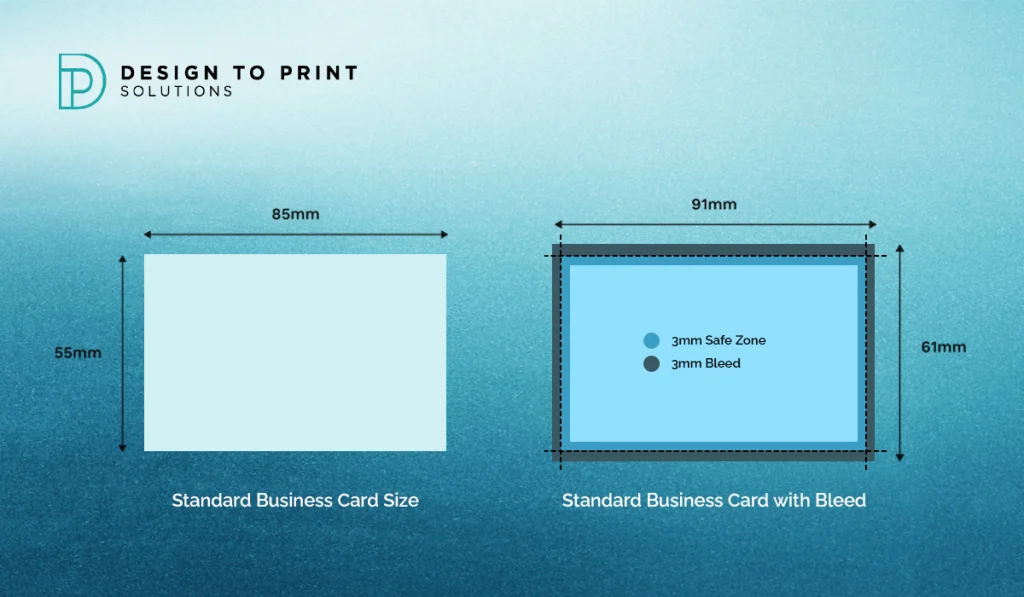
Bleed is the extra area that extends beyond the finished card size, usually 3 mm on each edge. When the card is trimmed, this bleed is cut away, ensuring backgrounds or images go right to the edge with no accidental white slivers. For a 90 × 55 mm card, many printers ask for artwork set to 96 × 61 mm, with important text pulled back from the edges so it can’t be accidentally trimmed.
In practice, that means:
- Finished size (trim): 90 × 55 mm
- Bleed size: 96 × 61 mm (3 mm all around)
- Safe area: keep text and logos roughly 3 mm inside the trim line
If you’re unsure, DTPS can check your file, add bleed correctly, or set up a fresh business card design from scratch so your print is ready for the press.
Business card design guide: layout tips that work
Looking at leading online guides from Vistaprint, Snap and Gorilla Print, a few clear patterns show up in every strong business card design guide: keep it simple, make the logo visible, and give breathing space to your text.
Here are practical layout tips DTPS clients often use:
- Lead with your logo
Make your logo the focal point, usually on one side of the card. Avoid shrinking it to the point where it competes with your contact details.
- Use a clear visual hierarchy
Name and role first, then main contact channels (phone, email, website), then social icons or QR code. A simple hierarchy makes scanning the card effortless.
- Limit fonts and colours
Two fonts and a small, brand-consistent colour palette are usually enough. This keeps your business card sizing and layout clean rather than cluttered.
- Think about orientation
Horizontal cards feel familiar and safe; vertical cards feel more contemporary. Both can work, but choose one that suits your brand personality.
- Don’t forget the back
Use the reverse side for a tagline, appointment table, mini product list or QR code – anything that genuinely helps the person keep and use your card.
If you’re not comfortable setting up print files, DTPS’s in-house team can handle both design and printing so you only need to sign off the final proof.
Business card printing tips from a local printer
A size guide is only half the story. The other half lives in the Business card printing choices you make:
- Stock weight: Thicker stocks (around 350–450 gsm) feel more substantial and resist wear.
- Finish: Matte laminate for a modern, understated look; gloss laminate for punchy colour; soft-touch or textured options if you want a more tactile feel.
- Colour setup: Always supply artwork in CMYK rather than RGB so the printed colours match expectations.
- Consistency: If you reprint regularly, choose a printer (like DTPS) that keeps profiles and job specs on file, so reorders match previous runs.
Because DTPS is based on the Mornington Peninsula and prints everything locally, you can also review hard proofs, talk through finishes in person and match your business cards to other items like brochures, swing tags or presentation folders.
When to choose a non-standard business card size
Standard dimensions keep things simple, but custom sizes can support specific brand goals:
- Square cards – good for bold logos, creative industries or minimal text.
- Slimline cards – ideal for sleek brands or when you want something that still fits holders but looks a little unexpected.
- Mini cards – handy for appointment cards, loyalty details or as a compact “secondary” card.
The key is balance. A non-standard business card size should still slide into a wallet and carry essential information without crowding. DTPS can help you weigh up readability, practicality and cost before you commit to a unique format
Conclusion
Choosing the right business card size is more than following a template — it’s about creating something people actually want to keep. The standard Australian size of 90 × 55 mm remains popular because it balances practicality with enough room for clear branding. Once you understand dimensions, bleed, safe zones and the way different stocks behave in print, designing a card that looks sharp and feels premium becomes much easier.
Whether you’re supplying press-ready artwork or starting from a blank canvas, the team at DTPS can guide you through every step — from layout suggestions to stock choices and specialty finishes. With the right preparation and a little help from a local printer, your business card becomes more than a contact detail holder. It becomes a small, memorable piece of your brand that fits neatly into someone’s hand and stays with them long after your first meeting.
FAQ:
What is the standard business card bleed size?
Most printers require a 3 mm bleed on all sides, meaning your artwork should be set to 96 × 61 mm for a 90 × 55 mm card. Bleed ensures the background reaches the edge after trimming, preventing accidental white borders. Designers should also keep important elements inside a “safe zone” around 3 mm inside the trim line. This setup helps produce a clean, professional, edge-to-edge finish.
What are the business card dimensions in inches?
Australia’s standard 90 × 55 mm business card converts to roughly 3.54″ × 2.17″. If you’re using international templates, you may see 3.5″ × 2″ formats, which are close but slightly smaller. To avoid misalignment during trimming, always adjust your artwork to the Australian size. Ensuring dimensions match local printing standards keeps your final design accurate and well-aligned.
What is the best size for business card design?
For most brands, the best business card size is the Australian standard 90 × 55 mm, as it provides the ideal balance of branding space and portability. It gives designers enough room for logos, typography and contact details without feeling cramped. Alternative shapes like square or slimline cards can work well for creative brands, but they must still fit comfortably in wallets and holders.
Do different business card sizes affect printing cost?
Yes, business card size can influence printing cost. Standard 90 × 55 mm cards are usually the most cost-effective because printing plates, cutting guides and stock are optimised for this size. Custom or non-standard dimensions may require extra trimming or special stock handling, increasing setup time and production cost. If budget is a consideration, sticking to the standard size is the most efficient option.
