
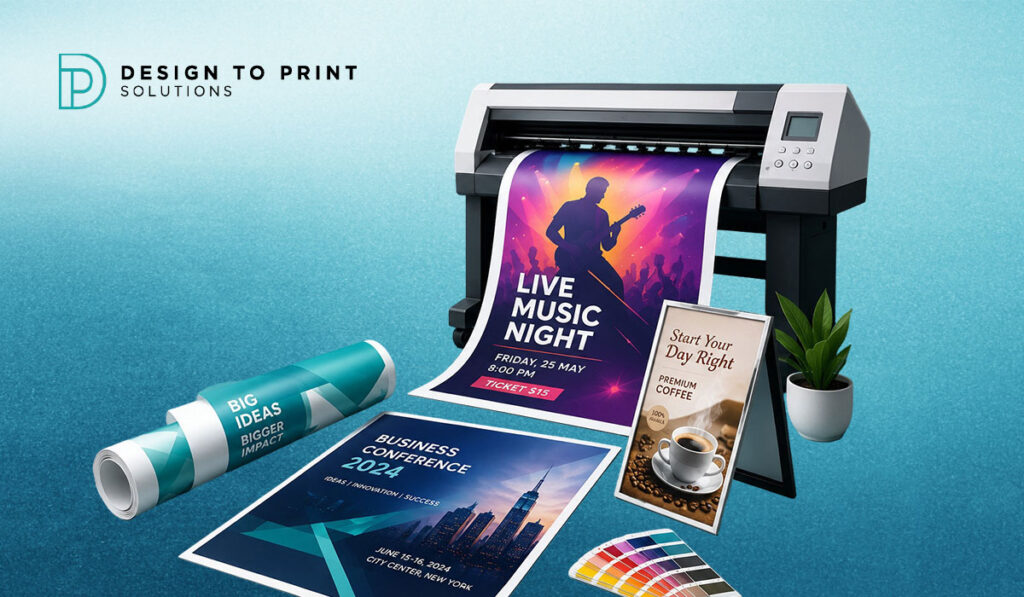
Whether you are promoting a grand opening in Carlton, advertising a community event in Mornington, or running a suburb-wide retail campaign across Dandenong — understanding how poster printing works before you place your order can save you time, money, and the frustration of a costly reprint. This complete guide covers everything Melbourne and Mornington Peninsula businesses need to know, from choosing the right paper size to preparing print-ready artwork and understanding what you will pay.
1. What Is Poster Printing and Why Does It Still Work?
Poster printing is the process of producing large-format printed sheets — typically from A3 up to A0 and beyond — for display in public-facing locations such as retail windows, community noticeboards, event venues, construction hoardings, and street-level display sites.
Despite the dominance of digital advertising, printed posters remain one of the most cost-effective and high-recall marketing formats available to Melbourne businesses in 2025. The reason is both psychological and neurological. Physical print engages the brain differently to a screen. A passerby on Brunswick Street, Chapel Street, Lygon Street, or the Mornington main strip cannot scroll past a well-placed A1 poster — it demands attention in a way that a 2-second digital ad impression simply cannot replicate.
Studies consistently show that:
- Printed marketing materials generate up to 3× higher brand recall than digital display advertising
- 71% of consumers say print feels more credible and trustworthy than online advertising
- 82% of people notice outdoor poster advertising in high-foot-traffic areas
- Once printed, a poster carries zero ongoing media cost — it works 24 hours a day, 7 days a week
From event promotion and retail campaigns to real estate hoardings and community noticeboards, poster printing serves Melbourne businesses across virtually every industry — hospitality, retail, real estate, education, health, construction, and the arts.
2. Choosing the Right Poster Size for Your Campaign
Selecting the correct poster size is the single most important decision you will make before placing your print order. Too small and your message gets lost in the visual noise of a busy street or shopping centre. Too large and you may not have the available wall space, display stand, or budget to justify it. Here is a practical breakdown of the standard A-series paper sizes used in Australian poster printing:
A3 (297 × 420 mm) The smallest practical poster size for most marketing applications. Ideal for café and restaurant noticeboards, retail counter displays, community pinboards, school corridors, and gym reception areas. Best viewed from within one metre. Perfect for high-volume, cost-effective distribution campaigns across inner Melbourne suburbs like Fitzroy North, Preston, Moonee Ponds, Thornbury, and Coburg.
A2 (420 × 594 mm) A versatile mid-size format that works well in retail windows, community centres, bar and café interiors, gymnasium noticeboards, and event venue foyers. Clearly legible from 2–3 metres. A strong choice for local businesses in South Yarra, Hawthorn, St Kilda, Prahran, and Port Melbourne.
A1 (594 × 841 mm) The workhorse of street-level marketing in Melbourne. Highly visible in retail windows, snap-lock poster frames, shopping centre lightboxes, and event display stands. Legible from 5+ metres when designed correctly. Widely used for event launches, campaign announcements, and seasonal retail promotions across Melbourne CBD, Richmond, Carlton, Brunswick, and Collingwood.
A0 (841 × 1189 mm) Maximum visual impact for trade shows, expos, construction hoardings, shopping centre displays, and building site signage. At one full square metre of printable space, A0 printing is also the standard format for architectural drawings, engineering plans, and technical site maps across Melbourne’s active construction precincts in Docklands, Southbank, Werribee, and Cranbourne.
A useful rule of thumb: The further away your audience will be when they first see your poster, the larger the format you need. A poster for a noticeboard viewed from 50 cm can be A3. A poster on a street-facing retail window needs to be A2 at minimum — and ideally A1 — for maximum legibility from the footpath.
Important: Never design artwork at a smaller size and ask your printer to scale it up. Scaling up a design that was not built at the correct resolution will produce a blurry, pixelated result. Always design at your final print size at 300 DPI minimum.
3. Paper Stock and Finish Options Explained
The stock and finish you choose affects how your poster looks, how long it lasts, and where it can safely be displayed. Here is what Melbourne businesses need to know about the most common poster printing options:
Gloss Coated Stock The most widely used poster stock in Australia. Produces vibrant, saturated colours with a shiny, reflective surface. Easy to wipe clean. Available in weights from 130 gsm to 200 gsm. Ideal for retail promotions, event posters, hospitality marketing, and any short-to-medium-term indoor display. The go-to choice for most Melbourne businesses.
Matte Coated Stock A smooth, non-reflective surface that gives posters a sophisticated, premium feel. Colours appear softer and more refined than gloss. Preferred by galleries, professional services offices, architects, luxury retailers, and upmarket venues in Toorak, Brighton, Armadale, and Camberwell. Text and fine detail read more clearly on matte than gloss due to the absence of glare.
Silk / Satin Stock A middle ground between gloss and matte. Excellent colour reproduction without the strong reflectivity of gloss. Popular for photographic prints, menu displays, and art reproduction. Widely used by hospitality businesses and creative studios across Fitzroy, Collingwood, and Richmond.
Waterproof / Vinyl Stock A non-paper substrate designed for outdoor display. Completely resistant to moisture, UV exposure, and temperature fluctuation. Essential for any poster displayed outdoors across Melbourne’s inner suburbs, or in coastal and exposed locations along the Mornington Peninsula from Hastings to Sorrento. More durable and longer-lasting than any paper-based stock in outdoor conditions.
Laminated Gloss A standard coated poster with a gloss laminate film applied to the face. Dramatically increases durability, moisture resistance, and surface strength. Protects inks from UV fading. Recommended for any outdoor display lasting more than one week, and for high-traffic indoor environments where posters may be touched, bumped, or exposed to moisture from cleaning.
Laminated Matte Combines the premium look of matte stock with the durability of a protective laminate layer. The choice of corporate showrooms, real estate offices, and high-end retail environments where longevity and presentation are equally important.
Choosing your weight (gsm):
- 130–150 gsm — lightweight, cost-effective, ideal for short-term indoor display and high-volume runs
- 170–200 gsm — standard weight for most retail and event applications, good rigidity for A2 and A1
- 200 gsm+ — heavyweight, suitable for long-term display, high-traffic locations, and any poster that will be handled or frequently pinned and unpinned
4. How to Prepare Your Artwork for Print
Artwork preparation is where the majority of print problems originate. Submitting a file that is not print-ready leads to delays, unexpected colour shifts, blurry output, and in the worst cases, an entirely reprinted job. Here is exactly what every Melbourne business needs to know before sending artwork to their printer:
Resolution — Minimum 300 DPI at Final Print Size A file that looks sharp and crisp on your screen at 72 DPI will print blurry and pixelated at A1 or A0. This is the single most common cause of disappointing poster print results. Always export and save your artwork at 300 DPI at your target print dimensions. If you are printing at A1, your file must be 300 DPI at A1 — not at A4 then scaled up.
Colour Mode — CMYK, Not RGB Screens display colour using RGB (red, green, blue) light. Printers produce colour using CMYK (cyan, magenta, yellow, black) inks. These are fundamentally different systems and they do not translate perfectly. If you submit an RGB file, your printer will convert it to CMYK — and colours, particularly vibrant reds, electric blues, bright oranges, and fluorescent tones, can shift noticeably in the conversion. Design in CMYK from the start to ensure what you see on screen matches what comes off the press.
Bleed — Add 3 mm on All Four Sides When a poster is trimmed to its final size after printing, even a 1–2 mm variation in the cutting position can leave a thin white border where your background colour was intended to run all the way to the edge. Adding 3 mm of bleed — extending your background, images, and any edge-to-edge design elements beyond the final trim line by 3 mm on all four sides — eliminates this problem entirely.
Safe Zone — Keep Critical Content 5 mm Inside the Trim Edge Text, logos, important graphic elements, and key visual content should sit at least 5 mm inside the final trim line. This ensures that nothing critical is accidentally cut off during the trimming and finishing process.
File Format — PDF (Print-Ready) Is Preferred Save your poster artwork as a high-resolution PDF/X-1a or PDF/X-4 with all fonts embedded and all images at full print resolution. Adobe Illustrator AI files are also widely accepted. High-resolution TIFF files work well for photographic or image-heavy designs. If submitting a JPEG, save at maximum quality (quality setting 12) at full print dimensions.
Font Embedding — Embed or Outline All Fonts If your fonts are not embedded in your file, your printer’s production system may substitute a different font automatically — completely changing the visual appearance, letter spacing, and layout of your design. Always embed your fonts before exporting to PDF, or convert all text to outlines (curves) in Illustrator or InDesign before saving.
Proofing — Always Approve a Digital Proof Before Printing Never assume that what you see on your screen will translate identically to print without a proof. A calibrated digital proof from your printer shows exactly how your colours, layout, bleed, and text will appear on the finished poster. Approving a proof before production starts is the single most effective way to eliminate surprises and avoid reprints.
Every file submitted to DTPS is reviewed by our team before it goes to press. We check resolution, colour mode, bleed, and safe zones and flag any issues before printing — so you never receive a finished job that does not match your expectations.
5. Indoor vs Outdoor Poster Printing
The distinction between indoor and outdoor poster printing is more significant than most people realise, and choosing the wrong specification for your display environment is one of the most common and costly mistakes in print marketing.
Indoor Poster Printing
Indoor posters are designed for protected, climate-controlled environments: retail shopfronts (inside-facing window displays), café and restaurant interiors, offices, schools, community centres, shopping centre interiors, and event venue foyers. They do not need to withstand UV radiation, rain, wind, or temperature extremes, so lighter paper stocks and non-laminated finishes are perfectly appropriate and significantly more cost-effective.
Standard coated stocks from 130 gsm to 200 gsm on gloss or matte finish are ideal for most Melbourne indoor applications — from boutique windows on Chapel Street in South Yarra to community noticeboards in Coburg, Preston, and Moonee Ponds.
Outdoor Poster Printing
Outdoor posters face the full force of Melbourne’s variable climate: intense summer UV that fades unprotected inks within weeks, autumn rain that destroys standard paper stock within days of exposure, and the salt-laden coastal air of Mornington Peninsula locations that accelerates material degradation significantly faster than inland sites.
Any poster designed for outdoor display — street poles, hoardings, external window-facing displays, building site fences, outdoor event signage, or coastal-facing locations — requires:
- Waterproof or water-resistant substrate, typically vinyl or coated waterproof paper
- UV-resistant inks that will not fade or yellow in direct Australian sunlight
- Gloss or matte lamination for additional surface protection and moisture resistance
- Heavier substrate weights (200 gsm or above) for structural rigidity in wind and handling
- Grommets, pole pockets, or reinforced edges if the poster will be hung or suspended
For businesses on the Mornington Peninsula — fromMornington and Mount Eliza through toHastings, Rosebud, Rye, and Sorrento — always specify weatherproof outdoor stock for any poster displayed within 500 metres of the coastline. Salt air dramatically accelerates the degradation of standard coated paper and even laminated stock, particularly during the peak summer season.
6. How Much Does Poster Printing Cost in Melbourne?
Poster printing costs in Melbourne vary based on five key variables: size, quantity, paper stock, finish, and turnaround time. Understanding how each variable affects your total cost helps you budget accurately and get the best value from your print investment.
Size Larger formats require more material and more press time, so cost more per unit. An A3 poster is significantly cheaper per unit than an A1, which in turn costs less than an A0. However, the cost difference between sizes narrows considerably at higher quantities.
Quantity This is where the most significant savings are available. Digital printing has a fixed setup cost that is spread across every unit in the run. Ordering 100 copies of an A2 poster costs far less per unit than ordering 10. If you are planning a suburb-wide distribution campaign across Carlton, Dandenong, or Melbourne CBD, ordering in bulk is always the most cost-effective approach.
Stock and Finish Standard coated stocks are the most affordable option. Lamination, waterproof vinyl, and specialty finishes add cost per unit but dramatically extend the lifespan and perceived quality of your finished poster. For short-term event promotions lasting one to two weeks, standard gloss stock is usually the right call. For long-term retail displays or outdoor campaigns running a month or more, the added investment in premium stock pays for itself in durability alone.
Turnaround Time Standard production is 2–3 business days from artwork approval. Express 24-hour production is available for urgent campaigns but carries a premium. Planning your print campaign at least 5–7 business days before your display date eliminates the need for express pricing entirely and gives you time to review and approve a proof without pressure.
Design If you require graphic design services to create or finalise your poster artwork, design fees are quoted separately as part of your overall job estimate. Providing complete, print-ready artwork avoids design costs and speeds up the production process.
A well-planned Melbourne poster print run often costs less than a single day’s budget on Google Ads — and unlike a digital ad that disappears the moment you stop paying, a printed poster continues to work for weeks or months without any additional spend.
7. The Poster Printing Process — Step by Step
Understanding how the production process works from initial brief through to finished, delivered poster helps you plan your campaign timeline and avoid unnecessary delays. Here is exactly what happens when you order poster printing through DTPS:
Step 1 — Get a Quote Contact us online via our quote request form, by phone on (03) 5977 7119, or visit our Somerville workshop in person. Share your required size, quantity, finish preference, intended display environment (indoor or outdoor), and your deadline. We provide a clear, itemised quote with no hidden costs — typically within a few hours for standard requests.
Step 2 — Submit Your Artwork Upload your print-ready file (PDF preferred, 300 DPI, CMYK colour mode, with 3 mm bleed on all sides) through our online portal, by email, or in person on a USB drive. If your artwork is not yet print-ready, our in-house design team can help — from minor file adjustments through to a complete design created from your brief.
Step 3 — Artwork Review and Proofing Every file received by DTPS is reviewed by our production team before it goes to press. We check your file for resolution, colour mode, bleed, safe zones, font embedding, and any other technical issues. If we find a problem, we contact you before production begins — never after. A digital proof is provided for your approval so you can confirm the layout, colour, and content are exactly as intended.
Step 4 — Approve and Go to Press Once you approve the digital proof, your job enters production on our high-resolution digital press. We use professional CMYK press equipment to ensure accurate colour reproduction and sharp detail at every size from A3 through to A0.
Step 5 — Finishing After printing, your posters go through any required finishing processes — trimming to final size, lamination, cutting, or any other specified treatments — all completed in-house at our Somerville workshop without outsourcing.
Step 6 — Collect or Delivery Collect from our Somerville workshop — conveniently located for clients across the Mornington Peninsula includingMornington,Hastings, andRye — or arrange delivery to any Melbourne metro suburb. We deliver toMelbourne CBD,Southbank,Docklands,Carlton,Dandenong,Werribee, and all surrounding suburbs. We also ship Australia-wide for interstate clients.
8. Dos and Don’ts of Effective Poster Design
A technically perfect print job can still fail to deliver results if the design does not communicate clearly and quickly. In Melbourne’s busy visual environment — whether that is a crowded Fitzroy laneway, the Dandenong Market precinct, or a Mornington Peninsula tourism strip in peak summer — your poster has approximately two to three seconds to capture attention and communicate its key message.
Do this:
- Use a single, dominant headline that is readable from at least three metres away without squinting
- Design with one clear, unambiguous call to action — a QR code, a phone number, a website URL, or a physical address
- Use high-contrast colour combinations for maximum outdoor legibility in direct Australian sunlight
- Leave generous white space around key elements — crowded, text-heavy posters are rarely read and quickly ignored
- Choose body text fonts at 24 pt minimum for A1 and above — anything smaller disappears at reading distance
- Position your brand logo consistently and prominently so it is the first or last thing a viewer’s eye lands on
- Design at your final print dimensions from the very beginning — never scale up from a small file
- Pair your poster campaign with complementary flyer printing for letterbox or hand-to-hand distribution in your target suburb
- Include a dynamic QR code that links to a trackable landing page so you can measure campaign performance in real time
Avoid this:
- Using more than two typefaces in a single poster — visual consistency builds credibility and aids legibility
- Trying to communicate more than one primary message — diluting your focus dilutes your impact
- Low-contrast colour combinations that disappear in sunlight — yellow text on white, light grey on off-white, and pale pastels on pastel backgrounds are all high-risk
- Including excessive small print unless legally required — if it cannot be read comfortably from the intended viewing distance, it should not be on the poster
- Using stock photography sourced from the web at screen resolution (72 DPI) — it will print soft and blurry at A2 and above
- Submitting RGB files and assuming the CMYK conversion will produce accurate, true-to-brand colours
- Skipping the proof approval step — always review and formally approve a digital proof before your job enters production
9. Poster Printing for Specific Industries in Melbourne
Different industries across Melbourne and the Mornington Peninsula use poster printing in distinctly different ways. Here is how some of the most active local sectors make poster printing work for their specific marketing needs:
Hospitality — Cafés, Restaurants, and Bars Melbourne’s world-renowned café culture from Fitzroy and Collingwood to the Mornington Peninsula’s coastal dining strip generates constant demand for menu posters, daily specials boards, event announcements, and seasonal promotion displays. Waterproof laminated stock is highly recommended for any café or restaurant poster that will be displayed near a kitchen, coffee machine, or outdoor dining area. Pair your poster campaign with matching brochure printing for take-home menus and event programs.
Real Estate Property developers and real estate agencies across Melbourne’s active growth corridors — Werribee, Cranbourne, Dandenong, and the Mornington Peninsula — use large-format A1 and A0 poster printing for display suite windows, construction hoardings, open inspection signage, and project launch campaigns. High-gloss laminated stock is the industry standard for real estate display applications due to its durability, weather resistance, and premium visual impact.
Retail Whether you operate a boutique in South Yarra, a sporting goods store in Box Hill, or a homewares shop in Glen Waverley, retail poster printing drives in-store traffic, communicates seasonal offers, and reinforces brand identity at the critical final moment before a purchase decision. A1 and A2 window posters are particularly effective for converting foot traffic to walk-in customers during Melbourne’s key retail trading periods.
Events and Entertainment Concert promoters, festival organisers, theatre companies, community markets, and sporting clubs across Melbourne and the Peninsula rely on A2 and A1 event poster runs distributed across cafés, venues, and community boards in the weeks leading up to an event. For events that also need broad suburb-level reach, combining poster printing with a targetedflyer letterbox drop campaign dramatically increases total campaign coverage.
Construction and Architecture Builders, developers, and architectural practices across Melbourne’s inner and outer suburbs useA0 plan printing for site documentation, architectural drawings, engineering plans, and technical specifications. DTPS provides precise, to-scale plan printing in A0, A1, A2, and custom dimensions for construction industry clients across Melbourne CBD,Southbank,Docklands, and all surrounding suburbs.
Education and Community Organisations Schools, TAFEs, universities, sporting clubs, churches, and not-for-profits across Melbourne and the Mornington Peninsula use affordable A3 and A2 poster runs to promote enrolments, fundraisers, registration days, community events, and awareness campaigns. No minimum order means community organisations can order exactly the quantity they need — without committing to expensive large print runs.
10. Frequently Asked Questions About Poster Printing in Melbourne
What file format should I submit for poster printing?
A high-resolution PDF (PDF/X-1a or PDF/X-4) is the preferred file format. Your file should be set up at the final print size at 300 DPI, in CMYK colour mode, with a 3 mm bleed on all sides and all fonts embedded or converted to outlines. Adobe Illustrator AI files and high-resolution TIFF files are also accepted. Our team checks every file before production and will contact you about any issues before your job goes to press.
How long does poster printing take in Melbourne?
Standard turnaround for most poster sizes is 2–3 business days from artwork approval. Express 24-hour production is available for most formats at an additional cost. Same-day printing may be possible for smaller standard-size runs — contact our team directly for urgent requirements. We recommend planning your campaign at least 5–7 business days before your display date to allow comfortable proofing and approval time.
Can DTPS design my poster as well as print it?
Yes. Our in-house graphic design team creates fully print-ready artwork from scratch — briefed from nothing more than your logo, your key message, and your brand colours. We do not use generic templates. Every design is produced specifically for your business, your campaign, and your intended display environment. Design fees are included in your overall quote.
Is there a minimum order quantity?
There is no minimum order quantity at DTPS. We print single posters through to large commercial runs of thousands of units. Significant per-unit discounts apply at higher quantities — so if you need multiple copies for a suburb-wide campaign, ordering in bulk considerably reduces your total investment.
What is the difference between digital printing and offset printing for posters?
Digital printing sends your file directly from computer to press — no plates, no lengthy setup, fast turnaround, and fully cost-effective for short to medium print runs. It is the right choice for most Melbourne poster campaigns. Offset printing uses physical metal plates and becomes more cost-effective at very high volumes (typically 1,000+ copies) where the plate setup cost is spread across enough units to justify it. Read our detailed guide on digital printing vs offset printing for a full comparison.
Do you deliver poster printing across Melbourne and the Mornington Peninsula?
Yes. We deliver to all Melbourne metro suburbs, including Melbourne CBD,Southbank, Docklands,Carlton, Fitzroy, Richmond,Dandenong, Frankston,Werribee, and all surrounding areas. Peninsula clients can collect from our Somerville workshop or have orders delivered directly toMornington, Mount Eliza, Rosebud,Rye, Hastings, Dromana, and all surrounding Peninsula suburbs. We also ship Australia-wide.
Can I use a QR code on my printed poster?
Absolutely — and we strongly recommend it for any campaign where measuring results matters. A dynamic QR code printed on your poster allows you to track scan volume in real time, update the destination URL without reprinting, and connect your physical campaign directly to a landing page, booking form, or online store. QR codes should be printed at a minimum size of 3 × 3 cm with adequate clear space around them for reliable scanning.
Ready to Place Your Poster Printing Order?
Poster printing remains one of the most cost-effective, high-visibility marketing tools available to Melbourne and Mornington Peninsula businesses. And with the right printer behind you — one that checks your artwork, delivers consistent quality, and understands your local market — the process is straightforward from brief to finished poster.
At DTPS, we have been helping Melbourne and Peninsula businesses plan, design, and print campaigns that get noticed for over 17 years. From a single A3 window poster to a full A0 commercial print run, our team brings the same attention to quality, colour accuracy, and on-time delivery to every job — regardless of size. Get in touch today for a free quote — and let’s get your next poster campaign off the ground.
