
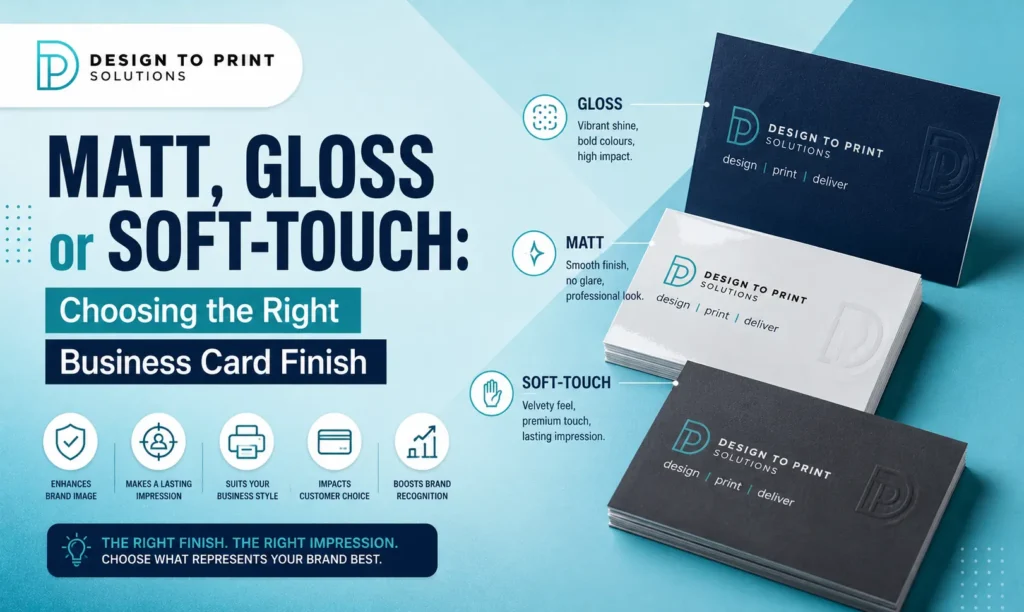
A business card is one of the smallest things your brand will ever produce, yet it carries an outsized amount of weight. It is often the first physical thing a potential client holds, and the impression it leaves lasts well beyond the handshake. Most people spend a long time on the design and the wording, then give barely a thought to the finish. That is a mistake, because the finish is what your card actually feels like, and feel is what people remember.
Matt, gloss and soft-touch are the three most popular business card finishes, and each sends a different message. One looks understated and modern, one is bright and vivid, and one feels unmistakably premium the moment it is touched. This guide walks through all three, comparing how they look, how they feel, how they hold up over time, and which type of business each one suits best.
What a finish actually is
Before comparing the options, it helps to understand what a finish is. The finish is the coating applied to the surface of the card after printing. It affects three things: how the card looks, how it feels in the hand, and how well it resists wear like scuffs, fingerprints and moisture.
The same design, printed on the same stock, can feel like a completely different card depending on the finish. This is why the choice matters as much as the artwork itself. Two businesses can use an identical layout, but the one that chose its finish deliberately will almost always feel more considered.
Matt finish: understated and modern
A matt finish has a smooth, non-reflective surface with a soft, subtle appearance. It has become the default choice for businesses that want to look modern, professional and a little understated. Without the shine of a gloss coating, colours appear slightly softer and more sophisticated, and the card has a clean, contemporary feel.
Matt is a favourite of designers, architects, consultants, accountants and corporate professionals, essentially anyone whose brand leans toward elegance over flash. One of its most practical advantages is that it is easy to write on. If you need people to jot a note on the back, or you want to add handwritten details, matt accepts pen far better than gloss.
The trade-offs are minor. Matt cards can show fingerprints and scuffs a little more readily than gloss, and very dark colours can occasionally pick up faint marks over time. For most users this is barely noticeable, and the refined look more than makes up for it.
Gloss finish: bright, vivid and durable
A gloss finish has a shiny, reflective surface that makes colours pop and images look sharp and vibrant. If your brand is bold, colourful or image-heavy, gloss brings it to life in a way matt cannot. Photographs, in particular, look crisp and rich under a gloss coating.
Gloss is well suited to retail, hospitality, real estate, photography and any business that relies on strong visuals. Beyond the look, gloss is also the most durable and practical of the everyday finishes. The coating resists moisture, smudging and general wear, so cards stay looking fresh in a wallet or cardholder. It is also typically the most cost-effective finish, which makes it a sensible choice for large print runs.
The main limitation is that gloss is difficult to write on, since pen tends to smudge or refuse to dry on the slick surface. It can also feel slightly less premium than matt or soft-touch, because the shine reads as more commercial than refined. For high-impact, visual brands on a budget, though, gloss is hard to beat.
Soft-touch finish: premium and memorable
Soft-touch is the finish people remember. It uses a special laminate that creates a velvety, almost suede-like surface, smooth and warm to the touch. The moment someone picks up a soft-touch card, they notice it, and that tactile surprise is exactly the point.
Soft-touch is the premium option, chosen by businesses that want to signal quality, luxury and attention to detail. It suits creative agencies, premium brands, executives, salons, boutiques and anyone whose first impression needs to feel high-end. Visually, it has a deep, matte-like richness that makes colours look elegant and considered.
There are two things to weigh up. Soft-touch is the most expensive of the three finishes, because of the specialised laminate involved, so it carries a higher unit cost. It can also show marks slightly more than gloss. But for businesses where the card is part of the brand experience rather than just a contact detail, the memorable feel justifies the premium. Pairing soft-touch with a heavier premium business card stock amplifies the effect even further.
Comparing the three at a glance
Each finish has a clear personality, and the right one depends on what you want your card to say.
Matt is understated, modern and easy to write on, with a moderate price and a refined look that suits professional and corporate brands. Gloss is vivid, durable and budget-friendly, making colours and images shine, ideal for bold and visual businesses, though it is hard to write on. Soft-touch is the premium, tactile choice that feels luxurious and memorable, perfect for high-end and creative brands, at a higher cost.
If you value elegance and the ability to write on the card, lean matt. If you want maximum colour impact and durability at a sensible price, choose gloss. If you want people to remember how the card felt, invest in soft-touch.
Finish is not the only decision
While the finish defines the surface, a couple of related choices shape the overall result just as much, and they work together with the finish to create the final impression.
Paper stock, or thickness, is the partner to your finish. A heavier, thicker stock feels substantial and premium in the hand, and it pairs especially well with matt and soft-touch. A flimsy card undermines even the nicest finish, so it is worth choosing a solid weight if you want the card to feel professional.
You can also combine finishes with special features for extra impact. Spot UV, for example, applies a glossy highlight to specific elements like a logo, which looks striking on an otherwise matt or soft-touch card. Foiling, embossing and rounded corners are other ways to lift a card further. These details are part of what separates a forgettable card from one that gets kept, and a good printer can talk you through which combinations work.
How to choose for your business
The simplest way to decide is to think about your brand personality and how the card will be used.
Start with the impression you want to leave. A law firm or accountant wants to feel trustworthy and refined, which points to matt. A photographer or café wants colour and energy, which suits gloss. A design studio or luxury brand wants to feel premium and distinctive, which calls for soft-touch.
Then consider the practical side. If people will write appointment times or notes on your cards, matt is the clear winner. If your cards live in wallets and need to survive daily wear, gloss holds up best. If the card is a deliberate part of a high-end customer experience, soft-touch earns its keep.
Finally, factor in budget and quantity. Gloss generally costs the least and scales well for large runs, matt sits in the middle, and soft-touch is the premium spend. For many businesses, the smartest approach is to match the finish to the value of the relationships the card is meant to build. A card handed to high-value clients is worth investing in.
Getting your business cards right
Your business card is small, but it works hard. The finish you choose shapes how it looks, how it feels and how long it lasts, so it deserves more than an afterthought. Matt for understated professionalism, gloss for vivid and durable impact, soft-touch for a premium feel people remember.
If you are not sure which finish suits your brand, the team at Design to Print Solutions can show you samples, recommend the right finish and stock combination, and make sure your artwork is set up correctly before printing. Request a quote and we will help you create a card that makes the right first impression.
Frequently Asked Questions
What is the difference between matt, gloss and soft-touch business cards?
Matt has a smooth, non-reflective surface that looks modern and understated and is easy to write on. Gloss has a shiny, reflective surface that makes colours and images vivid and is highly durable. Soft-touch uses a special laminate to create a velvety, premium feel that people tend to remember.
Which business card finish is the most durable?
Gloss is generally the most durable everyday finish, as its coating resists moisture, smudging and wear, so cards stay looking fresh in wallets and cardholders. Matt and soft-touch can show fingerprints and scuffs slightly more readily over time.
Can you write on a matt or gloss business card?
Matt is easy to write on and accepts pen well, which makes it ideal if you need to add handwritten notes or appointment details. Gloss is difficult to write on, as pen tends to smudge or not dry on the slick surface.
Is a soft-touch finish worth the extra cost?
For businesses where the card is part of the brand experience, such as creative agencies, premium brands and boutiques, the memorable tactile feel of soft-touch often justifies the higher cost. For high-volume, budget-focused runs, gloss or matt may be more practical.
Does paper stock matter as much as the finish?
Yes. The finish defines the surface, but the stock, or thickness, defines how substantial the card feels in the hand. A heavier stock pairs especially well with matt and soft-touch, while a flimsy card can undermine even a premium finish.
