
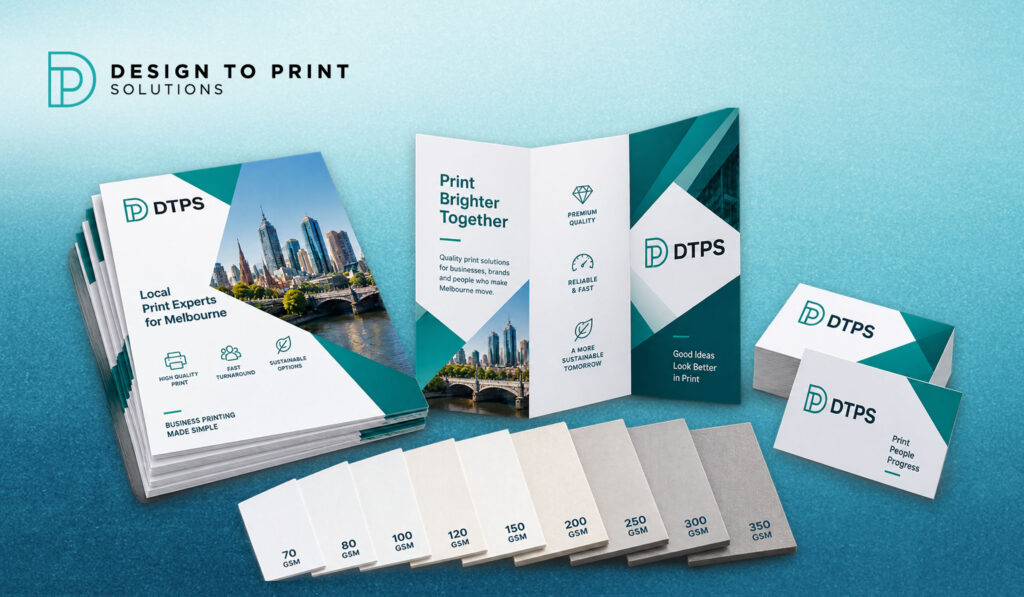
Choosing the best paper GSM for flyers, brochures and business cards is the decision that quietly makes print look either professional or cheap. Two jobs can share the same artwork and colours, yet the one on the right weight feels considered while the other feels flimsy the moment someone picks it up. GSM is where that difference is set, and it is easy to get right once you know the ranges.
Here is what GSM actually means, and the weights that work for each of the three most common marketing pieces.
What GSM actually means
GSM stands for grams per square metre. It measures how much a single square metre of a given stock weighs, which is a reliable proxy for how heavy and substantial the paper feels. Higher GSM generally means a thicker, stiffer, more premium sheet, and lower GSM means a lighter, more flexible one.
One caveat worth knowing: GSM measures weight, not thickness. A textured or bulky uncoated stock can feel thicker than a coated stock of the same GSM, because the coating compresses the sheet. Within the same paper type though, GSM is the number to compare, and it is the figure your printer will ask for. As a rough guide, anything up to about 170 GSM behaves like paper, while 200 GSM and above starts to behave like card.
Best GSM for flyers
Flyers cover a wide range, so the right weight depends on how the flyer is used.
For a high-volume letterbox drop or a handout at an event, 130 to 150 GSM does the job. It is light enough to distribute in large quantities and still holds a clean print. This is the everyday flyer weight, and it suits promotions, menus and local advertising where the piece has a short life.
For a premium single-page flyer, a real estate feature sheet, a product one-pager or an upmarket invitation, step up to 170 GSM. The extra weight signals quality the instant someone takes it, which matters when the flyer is representing a brand rather than just carrying a message. If you want it to survive handling or outdoor display, lamination adds durability on top of the base stock.
Once you have settled on a weight, our flyer size guide helps you match it to the right dimensions, and you can spec the full job on the flyer printing page. If you are still deciding between a flyer and a folded piece, our explainer on the difference between a brochure and a flyer is a good starting point.
Best GSM for brochures
Brochures split into two camps, and each has its own answer.
A single-sheet folded brochure, the classic DL or A4 folded into a DL, works best on 150 to 170 GSM. That range is heavy enough to hold a crisp fold without cracking and light enough to sit neatly in a display stand or envelope. A 170 GSM folded brochure is a safe, professional default for most businesses.
A multi-page or bound brochure is different, because the cover and the inside pages usually run on different stocks. The internal text pages sit around 115 to 150 GSM so the booklet stays flexible and does not become heavy or awkward to hold. The cover jumps up to 250 to 350 GSM to protect the pages and give the piece a solid, premium open. This cover-and-text combination is standard for company profiles, catalogues and property magazines.
For artwork setup, folds and bleed, our guide on how to print a brochure walks through getting print-ready files, and the folded brochure page covers format options. There is more on the marketing side in our post on boosting your brand with brochure printing.
Best GSM for business cards
Business cards are where GSM matters most, because the card is judged entirely by feel. A thin card marks a brand down before a word is read.
The sensible minimum is 300 GSM. Below that, a card bends too easily and feels disposable. The Australian standard and the weight most businesses should choose is 350 GSM, which gives a firm, quality card that holds up in a wallet and survives being handed around. For a premium finish, 400 GSM and above delivers a noticeably more substantial card, and duplexed or triplexed cards bonded to 600 GSM or more create the thick, luxury feel used by design studios and high-end brands.
Finish plays into the decision as well. A matt or soft-touch laminate on a 350 GSM card feels more expensive than gloss on the same weight, so the coating and the GSM work together. Our business card printing guide for Melbourne covers stocks and finishes in detail, the business card size guide sorts out dimensions, and the business cards page has the options.
Quick GSM reference
| Print piece | Recommended GSM | Notes |
| Letterbox and event flyers | 130 to 150 GSM | Light, high-volume, short life |
| Premium flyers and feature sheets | 170 GSM | Quality feel, brand-facing |
| Folded brochures (single sheet) | 150 to 170 GSM | Folds cleanly, holds shape |
| Brochure inner pages | 115 to 150 GSM | Keeps a booklet flexible |
| Brochure and booklet covers | 250 to 350 GSM | Protects and lifts the piece |
| Business cards (standard) | 350 GSM | Australian everyday standard |
| Business cards (premium) | 400 GSM and above | Substantial, luxury feel |
| Presentation folders | 300 to 400 GSM | Needs rigidity to hold inserts |
| Laminated postcards | 300 to 350 GSM | Durable for mail and handouts |
| Letterheads | 100 to 120 GSM | Must run through office printers |
You can see how these weights apply to related pieces on the laminated postcards, presentation folders and letterheads pages. For anything involving trimmed sizes, our paper size guide covering A0 to A6 is a handy companion.
Coating changes how a GSM feels
Two cards at the same 350 GSM can feel completely different depending on finish. A gloss coating adds shine and makes colours pop, which suits vibrant flyers and posters. A matt or silk finish reads as more refined and is easier to write on, which many businesses prefer for cards and corporate stationery. An uncoated stock feels natural and tactile, and it is the go-to for a warmer, understated brand. Lamination sits on top of all of these and adds both durability and a perception of thickness, so a laminated 350 GSM card feels closer to a heavier one.
Getting the weight right for your job
There is no single best GSM, only the right weight for how a piece will be used. Match the stock to the job: light for volume, medium for folding, heavy for anything that represents your brand in the hand. In a market like Melbourne, where a business card or brochure often lands next to several competitors on the same day, that feel is part of the first impression.
Design to Print Solutions prints flyers, brochures, business cards and full stationery sets on a wide range of stocks and finishes, and can recommend the ideal GSM for your specific job. Send your artwork or a brief through the contact page and request an itemised quote, specified to the exact stock, size and finish your project needs.
Frequently asked questions
What GSM is best for business cards?
350 GSM is the Australian standard and the safe choice for a firm, professional card. Step up to 400 GSM or a duplexed stock for a premium, thicker feel, and treat 300 GSM as the minimum before a card starts to feel flimsy.
What is the best paper weight for flyers?
130 to 150 GSM suits high-volume letterbox drops and event handouts, while 170 GSM gives a premium single-page flyer a quality feel. Choose the lighter end for volume and the heavier end when the flyer represents your brand.
What GSM should a brochure be?
A single-sheet folded brochure works best at 150 to 170 GSM. For a multi-page brochure, run the inside pages at 115 to 150 GSM and the cover at 250 to 350 GSM so the piece stays flexible but feels solid.
Is higher GSM always better?
Not always, because GSM should match the job. A folded brochure on very heavy stock cracks at the fold, and a letterhead that is too thick will jam an office printer. The right weight depends on how the piece is used, not simply on being the heaviest option.
Does GSM measure thickness?
GSM measures weight per square metre, not thickness directly. It is a reliable guide within the same paper type, though a textured uncoated stock can feel thicker than a coated one at the same GSM because coating compresses the sheet.
