
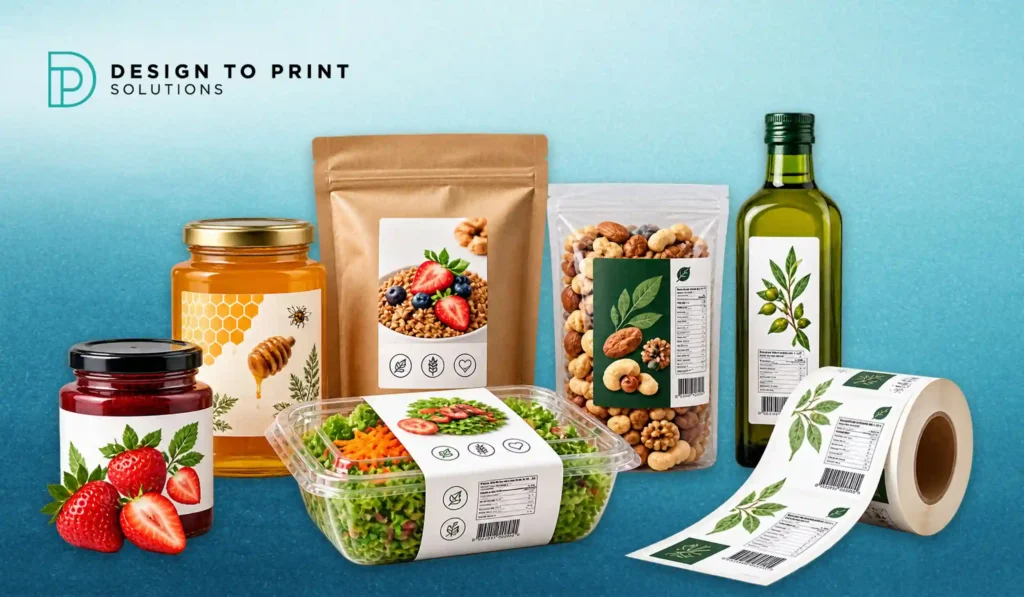
Food label requirements in Australia are set out in the Australia New Zealand Food Standards Code, and they are the one part of your packaging where creative freedom ends. A beautiful label that is missing a lot code, uses the wrong allergen wording or sets the type too small can force a full reprint, hold up a retail listing, or in the worst case trigger a recall.
For small food and beverage producers across Melbourne and the Mornington Peninsula, this is usually the first real hurdle between a finished product and a shelf. The good news is that the requirements are fixed and knowable. Once you understand what must appear, where it must appear and how legible it has to be, label artwork becomes a checklist rather than a guessing game.
This guide covers the mandatory information for packaged food sold in Australia, the rules that most often get missed at artwork stage, and how to prepare files so your label prints correctly the first time. It is general guidance only, not legal advice. Your product category may carry extra obligations, so confirm the detail with your state or territory food regulator before you commit to a print run.
Which Foods Need a Label
Most packaged food sold in retail in Australia must carry a label. The main exceptions are food that is unpackaged, food made and packaged on the premises where it is sold, food packed in the presence of the purchaser, whole or cut fresh fruit and vegetables in transparent packaging, and food sold at fundraising events.
Important point for small producers: an exemption from a full label does not mean an exemption from information. Allergen information and other key details still have to be provided to the customer on request or displayed with the food. If you make at a commercial kitchen and sell through markets, cafés or stockists, you almost certainly need a compliant label.
The Mandatory Information on a Packaged Food Label
Name or Description of the Food
The label must carry a name that makes the true nature of the food clear. Where the Code sets a prescribed name for a food, you must use it. Where it does not, your description has to be accurate enough that a shopper is not misled. A clever brand name alone is not sufficient: “Nonna’s Golden” needs “pasta sauce” alongside it.
Ingredient List
All ingredients are listed in descending order of ingoing weight. Compound ingredients must have their own sub-ingredients declared where they make up a significant portion of the final food. Additives are declared by their class name followed by the name or code number, for example “Preservative (202)”.
Allergen Declarations
This is the highest risk area on any food label. Plain English Allergen Labelling, under Standard 1.2.3, requires specified allergens to be declared using prescribed plain English terms, in bold, both within the ingredient list and in a separate “Contains” statement. The transition and stock in trade periods for these rules have now ended, so older label artwork is no longer protected.
The declarable allergens include cereals containing gluten, crustacea, egg, fish, milk, molluscs, peanut, sesame, soy, tree nuts, lupin, and added sulphites at or above the prescribed level. The required wording is specific: “milk” rather than “casein”, and individual tree nuts named rather than grouped. Precautionary statements such as “may contain” remain voluntary and are not a substitute for a proper declaration.
Date Marking
Food with a shelf life of less than two years needs a date mark. Use “Use by” where the food must be consumed before a date for health and safety reasons, and “Best before” where it is a quality date. Bread with a shelf life under seven days may use a baked on or baked for date. The date format and any accompanying storage instruction must be clear and durable on the label surface.
Nutrition Information Panel
Most packaged foods require a nutrition information panel in the prescribed format, showing energy in kilojoules, protein, fat, saturated fat, carbohydrate, sugars and sodium, expressed per serving and per 100g or 100mL. If you make a nutrition content or health claim, the relevant nutrient must also appear in the panel. FSANZ provides a nutrition panel calculator, though many producers use a lab analysis or a recipe based service for accuracy.
Percentage Labelling
Where an ingredient is named in the food name or shown prominently on the label, you generally must declare the percentage of that characterising ingredient. If your pack says “strawberry yoghurt” or shows strawberries on the front, the strawberry percentage needs to appear.
Lot Identification and Supplier Details
Every label needs lot identification so a specific production run can be traced and withdrawn if needed. You also need the name and street address of the supplier in Australia or New Zealand. A post office box is not sufficient: the address must include street number, street name, suburb or town and state. This is the detail most often left off a first label run.
Country of Origin
Country of origin labelling for most retail food in Australia is regulated separately to the Food Standards Code, through the information standard administered by the ACCC. Depending on the claim, your label may need the kangaroo in triangle logo, a bar chart showing the proportion of Australian ingredients, and an explanatory text statement. “Grown in”, “Product of”, “Made in” and “Packed in” each carry different legal thresholds, so pick the one you can actually substantiate.
Directions for Use and Storage, Warnings and Advisories
Where food needs particular handling to stay safe, storage directions are mandatory, for example “Keep refrigerated below 5°C”. Certain foods also require warning or advisory statements, such as those for foods containing added caffeine, royal jelly, unpasteurised products or aspartame.
Net Weight or Volume
Measurement marking sits under trade measurement law rather than the Food Standards Code. The net quantity must be in metric units, positioned in the prescribed area of the principal display panel, and set at a minimum character height determined by the size of the pack.
Legibility Rules That Catch People Out at Artwork Stage
Legibility requirements under Standard 1.2.9 are where great design and compliance most often collide. Label text must be in English, legible, and in a colour that contrasts distinctly with its background. Warning statements carry a specific minimum size, generally 3mm, reduced to 1.5mm on small packages, and general label text has its own minimum height.
In practice, this means low contrast trends such as pale grey type on cream kraft stock, or reversed white text on a light photographic background, will fail even though the file looks acceptable on screen. Metallic and foil backgrounds are another common problem: once printed, the contrast disappears under store lighting. Design the compliance panel for readability first, then style around it.
Health Star Rating: Still Voluntary, but Moving
The Health Star Rating has operated as a voluntary front of pack system. In February 2026, food ministers asked FSANZ to prepare a proposal to mandate it after voluntary uptake fell short of the agreed target, and FSANZ opened public consultation on Proposal P1067 later that year. No product is legally required to display a Health Star Rating today, and any change would come with a transition period.
The practical takeaway for producers is a print one. If you are investing in a long label run now, build artwork with space that could accommodate a front of pack rating later, so a future change is a panel update rather than a full redesign.
Claims: What You Can and Cannot Say
Nutrition content claims and health claims are permitted only where the food meets the relevant criteria in the Code, and health claims must be based on a pre-approved or self-substantiated relationship. Separately, Australian Consumer Law prohibits misleading or deceptive representations, which covers terms such as “natural”, “fresh”, “artisan” and sustainability claims. If you cannot evidence it, do not print it.
Choosing the Right Label Stock and Finish
Compliance survives only as long as the label does. A refrigerated product in a cool room, a jar in a dishwasher safe gift pack and a dry goods pouch in a warehouse all face different conditions.
For chilled, frozen and wet environments, a synthetic or vinyl face stock with a suitable adhesive will stay legible where a paper label wrinkles and lifts. For dry ambient products, a quality paper stock with a matt or gloss laminate gives a premium look while protecting the print from handling. Textured and uncoated stocks suit artisan positioning, but test fine print at actual size first, because small type can fill in on heavily textured surfaces.
Application method also matters. Labels on rolls suit volume production and machine application, while label sheets work well for short runs, seasonal lines and small batch producers hand applying in the kitchen. Retail and gift ranges often add swing tags or printed packaging boxes for presentation, and custom stickers handle promotional overlays, batch stickers and seasonal variations without reprinting the base label.
Preparing Print-Ready Label Artwork
Set files in CMYK, not RGB, and include 3mm bleed on all sides. Keep every piece of mandatory information at least 4mm inside the trim, because label dies have a small tolerance and a shaved lot code is a compliance failure, not just a cosmetic one.
Supply images at 300dpi at final size, outline or embed fonts, and avoid setting mandatory text below the minimum heights. Build the nutrition information panel as vector text rather than placing it as a flattened image, so it stays sharp at small sizes. If your label includes a barcode, supply it at the correct magnification with adequate quiet zones and sufficient contrast, since a scanner failure at the checkout will send you back to reprint.
At Design to Print Solutions (DTPS), our team checks every supplied file before production and flags issues such as missing bleed, low resolution artwork, RGB colour or text set too small to print cleanly, so problems surface before the press runs rather than after.
A Pre-Print Compliance Checklist
Before approving the proof, confirm the label carries the food name, ingredient list in descending order, bold allergen declarations with a “Contains” statement, date mark, nutrition information panel, percentage of characterising ingredients, lot identification, supplier name and full street address, country of origin, storage and use directions, any required warning statements and the net quantity. Then check contrast, minimum type sizes and that nothing sits in the bleed.
Finally, keep a signed proof on file against each lot code. If a question is ever raised about a production run, being able to produce the exact artwork approved for that batch is worth the two minutes it takes to save it.
Get your label artwork and quantities to us, and we will come back with an itemised quote covering the right stock, adhesive and finish for your product. Request a free quote or browse our full range of printing services.
FAQs:
What must legally be on a food label in Australia?
Most packaged food labels must show the name or description of the food, the ingredient list, allergen declarations, date marking, a nutrition information panel, percentage labelling of characterising ingredients, lot identification, the supplier’s name and street address, country of origin, storage and use directions, any required warning statements, and the net weight or volume. Requirements vary by product, so confirm with your state or territory food regulator.
Do I need a label if I sell at markets or through a local café?
If your product is packaged and sold to the customer in that package, it generally needs a compliant label. Food made and packaged on the premises where it is sold, or packed in front of the purchaser, may be exempt from a full label, but allergen and other key information must still be available to the customer.
What is PEAL and does it affect my existing labels?
Plain English Allergen Labelling requires allergens to be declared using specified plain English terms, in bold, in the ingredient list and in a separate “Contains” statement. The transition and stock in trade periods for these rules have ended, so labels printed under the older style are no longer covered and need updating.
What label material should I use for refrigerated or frozen products?
A synthetic or vinyl face stock with an adhesive rated for cold and damp application is the reliable choice. Standard paper labels absorb moisture in a cool room or display fridge, which causes edges to lift and printed text to blur, and illegible mandatory information is a compliance problem.
Is the Health Star Rating compulsory on packaged food?
Not currently. It has operated as a voluntary front of pack system, and in 2026 food ministers asked FSANZ to prepare a proposal to mandate it after voluntary uptake fell short of the target. Any change would follow public consultation and a transition period, so it is worth leaving design space on new artwork.
Can I print a small batch of labels to test a product before committing?
Yes. Short run digital printing is well suited to pilot batches, market testing and seasonal variants, and it lets you adjust wording or design between runs without the setup required for long production runs.
