
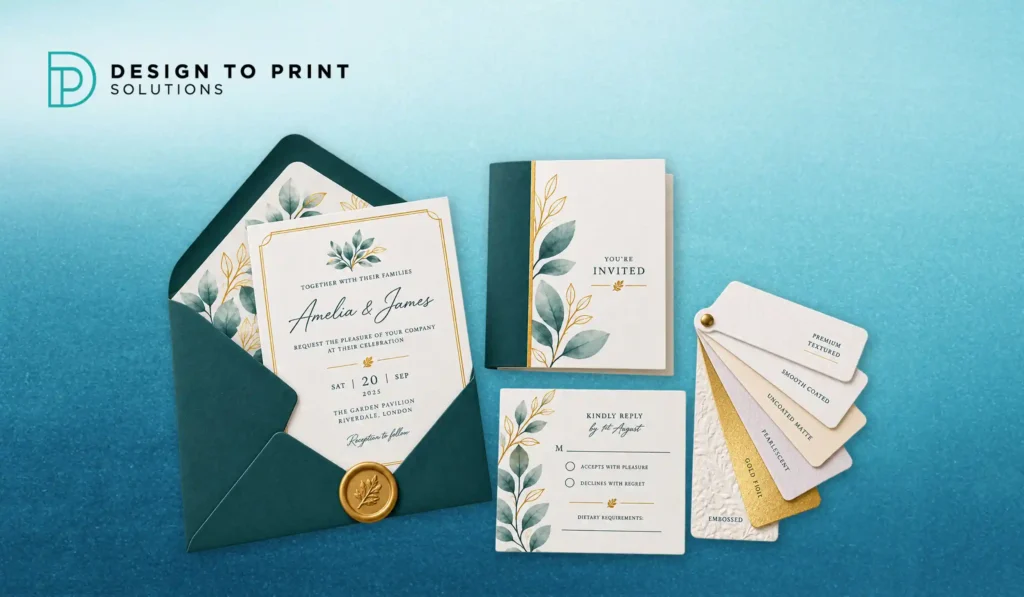
A printed invitation is the first physical thing a guest holds before your event, and it sets the tone before they read a single word. Getting it right comes down to three choices: the size, the paper it is printed on, and the finish. This guide walks through each one, shows how they fit different events, and explains how to hand a print-ready file to a printer so the result matches what you pictured.
The three decisions behind every printed invitation
Every invitation is shaped by three linked choices. Size sets how much you can fit and how the piece feels in the hand. Paper stock decides the weight, texture and how colour sits on the surface. Finish adds the final layer of polish, from a simple laminate to foil or a die-cut shape. The print method ties them together, and for most events digital printing covers the lot at short runs.
Decide these three in order and the rest of the job falls into place.
Invitation sizes and what they suit
Most Australian invitations use the A-series or a DL slip, with square trims popular for a modern look. Sizes are worked in millimetres here, which is the standard for print in Australia.
| Size | Dimensions (mm) | Typically used for |
| A5 | 148 x 210 | Larger, formal invitations with more detail |
| A6 | 105 x 148 | The classic invitation and save-the-date size |
| DL | 99 x 210 | Slim invitations, often folded from A4 |
| A7 | 74 x 105 | RSVP and reply cards, details cards |
| Square | 120 to 150 | Contemporary invitations (custom trim) |
A6 is the workhorse invitation size and suits almost any event. Step up to A5 when you have a lot of wording or want a more formal presence. DL works for tall, elegant layouts and folded suites. A7 is ideal for the smaller cards in a set, like the RSVP. If you want the full breakdown of the A-series and how the sizes relate, our paper size guide covering A0 to A6 explains the system.
Choosing the right paper stock
Stock is where an invitation gains its feel. Two numbers matter: the weight in GSM (grams per square metre) and the surface type.
For the main invitation, 300 to 350 gsm gives a solid, quality card that does not flop. Detail and RSVP cards work well slightly lighter, around 250 to 300 gsm. For a luxe piece, some invitations use double-thick stock of 600 gsm or more.
| Stock | Feel | Best for |
| Coated (silk or matt) | Smooth, strong colour | Photo invites, bold or vibrant designs |
| Uncoated | Natural, tactile, easy to write on | Classic and elegant invitations |
| Textured (linen, felt, laid) | Patterned surface | Formal and premium suites |
| Cotton or rag | Soft and thick | Letterpress and high-end pieces |
| Kraft or recycled | Rustic, natural tone | Relaxed, coastal or eco themes |
| Pearl or shimmer | Subtle metallic sheen | Evening and formal events |
Coated stock keeps photographs and bright colours sharp. Uncoated has a warmer, more tactile quality and takes handwriting and ink well, which matters if guests write on a reply card. Textured and specialty stocks carry a formal event nicely, though very heavy texture can soften fine detail, so keep small type generous.
Print methods, from digital to foil
Digital printing suits most event invitations. It handles full colour and photographs, works economically at the small quantities events call for, and allows variable data, so guest names can be printed individually. It is the practical default for birthdays, corporate functions and most weddings.
Premium methods exist for when you want something with more presence. Foil stamping presses metallic gold, silver or rose gold into the card for a reflective finish. Letterpress uses a deep impression on thick cotton stock for a tactile, traditional look. White ink prints pale designs onto dark or kraft stock. Spot UV lays a glossy, slightly raised coating over selected areas of a matt card. These specialty finishes vary by printer, so it is worth confirming what is available for your job before you settle on a design.
Finishes that lift an invitation
Finishing is the difference between a card that looks printed and one that looks considered. Common options include:
- Matt, gloss or soft-touch lamination for durability and feel
- Rounded corners for a softer, modern edge
- Die-cutting for custom shapes, including the arch shapes popular for weddings
- Duplex or triplex, where layers are bonded for extra thickness
- Deckle (torn) edges for a handmade look
- Embossing or debossing to raise or press a design into the stock
One well-chosen finish usually does more than several competing effects. Pick the detail that supports the design rather than fighting it.
Building a full invitation suite
For weddings and larger events, the invitation is rarely a single card. A full suite might include a save-the-date, the main invitation, a details or information card, an RSVP card, and on-the-day pieces such as menus, place cards and order of service. Thank you cards round it off afterwards.
Envelopes matter more than people expect, since they are the first thing seen. Matching printed envelopes keep a suite consistent, and a printed return address saves handwriting dozens of them. Save-the-dates work well as laminated postcards, and on-the-day menus can carry the same paper and finish as the invitation so the whole event feels of a piece.
Matching paper, size and finish to your event
The right combination depends on the occasion:
- Weddings and formal events: A5 or A6 on uncoated, textured or cotton stock, with foil or a subtle finish, matching envelopes and a coordinated suite.
- Corporate functions and galas: A5 or DL on coated or pearl stock, clean layout, a foil or spot UV logo for a professional edge.
- Birthdays and parties: A6 or square on coated stock so photos and bright colour stay vivid, with gloss lamination and rounded corners for a durable, playful card.
- Christenings and engagements: A6 on soft uncoated stock with a light, understated finish.
Use these as starting points rather than rules. The best result comes from matching the feel of the paper and finish to the mood of the event.
How to prepare invitation artwork for print
If you are supplying your own design, a print-ready file avoids delays and surprises. Work through this:
- Set the document to your final trim size (for example 105 x 148 mm for A6).
- Add 3 mm bleed on every side, and extend background colours or images to the bleed edge.
- Keep text and key elements inside a 3 to 5 mm safe margin from the trim.
- Design at 300 DPI so print stays sharp.
- Work in CMYK, not RGB, so screen colour matches the print.
- Embed or outline your fonts, then export a print-ready PDF.
- Check a proof or a printed sample before committing to the full run.
Before you approve anything, read every name, date, time, venue and RSVP detail twice. A spelling or date error is the one mistake a beautiful finish cannot fix.
When to send your invitations
Timing is part of the job. A common approach is to send save-the-dates around four to six months ahead, or earlier for destination or long-weekend events, and to post the main invitations roughly six to eight weeks before the event. An RSVP deadline three to four weeks out gives you time for final numbers. On top of that, allow lead time for design, proofing and printing, so start the print conversation well before the day you plan to send.
Printing event invitations in Melbourne
Design to Print Solutions prints invitations and event stationery for Melbourne and Mornington Peninsula clients, from a single card to a full suite. As a digital printer with an in-house design team, we can help with layout, print your files, and add finishes such as lamination, folding and die-cutting. We also print matching envelopes.
Because there is no minimum order, small event runs are straightforward, and reprinting extra RSVP or details cards later is easy. If you have a specialty finish in mind, mention it when you request a quote with your size, stock and quantity, and we will advise on the best way to produce it and provide an itemised quote.
Key takeaways
A good printed invitation comes down to three linked choices: size, paper and finish. A6 is the classic size, A5 for formal or detail-heavy pieces, DL and A7 for slim invites and reply cards. Choose 300 to 350 gsm for the main card, coated stock for vivid colour and uncoated for a tactile, writeable feel. Digital printing covers most event runs, with foil, letterpress and spot UV available for a premium look. Set artwork up at the trim size with 3 mm bleed, 300 DPI and CMYK, proof it carefully, and plan your timeline so printing is done well before you need to send.
Frequently asked questions about invitation printing
What size should event invitations be?
A6 (105 x 148 mm) is the most common size and suits most events. A5 gives more room for formal or detail-heavy invitations, DL works for slim designs, and A7 is ideal for RSVP and details cards.
What GSM should invitations be printed on?
Around 300 to 350 gsm for the main invitation so it feels solid, and 250 to 300 gsm for lighter detail and reply cards. Luxe pieces sometimes use double-thick 600 gsm stock.
Coated or uncoated paper for invitations?
Coated stock keeps photos and bright colours sharp, while uncoated has a natural, tactile feel and takes handwriting well. Classic and formal invitations often use uncoated or textured stock.
What is an invitation suite?
A coordinated set of pieces for one event, which can include a save-the-date, the main invitation, a details card, an RSVP card, and on-the-day items such as menus and place cards.
Can I print my own invitation design?
Yes. Supply a print-ready PDF at the correct trim size, with 3 mm bleed, 300 DPI resolution and CMYK colour, and fonts embedded or outlined.
How far in advance should I send invitations?
A common approach is save-the-dates four to six months ahead and invitations six to eight weeks before the event, with an RSVP deadline three to four weeks out. Allow extra time for design, proofing and printing.
Do you print matching envelopes?
Yes, envelopes are available and can be printed to match a suite, including a printed return address.
Can I order invitations in small quantities?
Yes. DTPS has no minimum order, so small event runs are fine and reprinting extra RSVP or details cards later is simple.
