
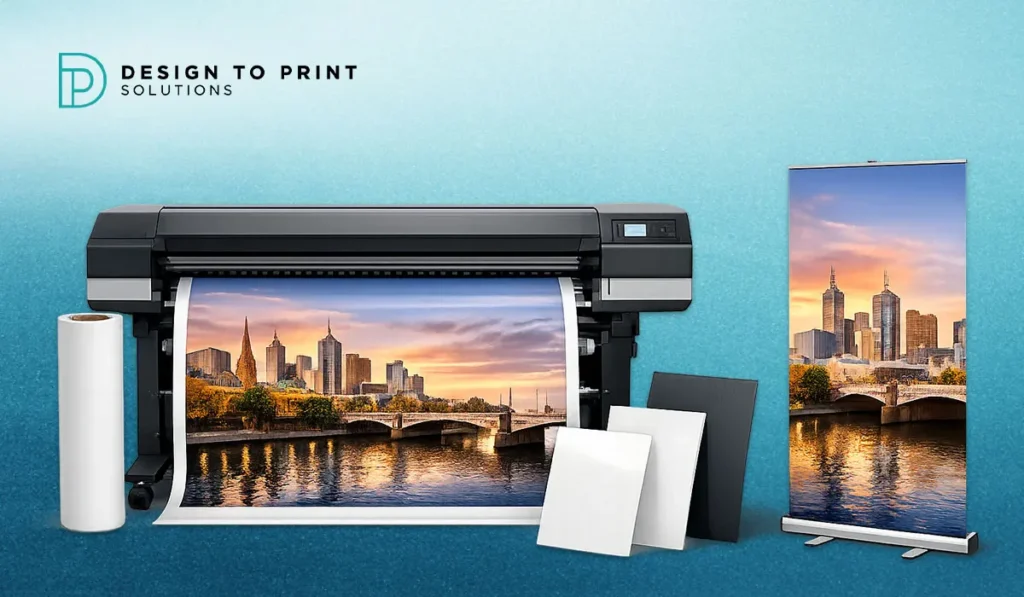
A pull-up banner at a Melbourne expo, a shopfront poster on Chapel Street, a printed hoarding wrapped around a CBD building site: large format printing is how businesses get noticed at scale. If you are planning any of these, the choices can feel confusing. What size should a banner be? Which material holds up through a Melbourne winter outdoors? How do you supply artwork that stays sharp once it is blown up to two metres tall? This guide covers large format printing in Melbourne from end to end, including the common sizes, the materials that suit each job, and how to prepare files that come out clean.
What is large format printing?
Large format printing produces oversized graphics that a standard office printer cannot handle, generally anything wider than A3. It covers posters, pull-up and vinyl banners, corflute signs, foamboard displays and fabric backdrops. Melbourne businesses use it for retail signage, trade shows, events, construction hoarding and outdoor advertising, printed on wide-format machines built for large sheets and rolls.
Common large format print sizes
Most large format jobs fall into two groups: posters that follow the standard A series, and banners that come in their own set of common sizes.
Posters usually run to these A sizes, though custom dimensions are easy to produce:
| Poster size | Millimetres | Typical use |
| A2 | 420 x 594 | Cafe specials, in-store promos |
| A1 | 594 x 841 | Retail windows, event advertising |
| A0 | 841 x 1189 | Exhibition displays, wayfinding |
A0 is the workhorse for high-visibility work. If you are weighing up the largest formats, our A0 paper size guide breaks down its uses in detail, and the full paper size guide covers every A size in one place.
Pull-up banners follow their own standards. The 850 x 2000 mm size is the most common across Australia, with wider options for bigger stands:
| Banner width | Height | Best for |
| 600 mm | 1600 mm | Tight spaces, reception desks |
| 850 mm | 2000 mm | The standard expo and retail banner |
| 1000 mm | 2000 mm | Feature displays |
| 1200 mm | 2000 mm | Wide backdrops and high-traffic areas |
Vinyl and mesh banners are made to order, so their size depends on the wall, fence or frame they are going on. Measure the mounting area first, then allow for hems and eyelets around the edge.
Large format printing materials
The material matters as much as the size. It decides how long the print lasts, whether it survives outdoors, and how sharp the finish looks up close.
Poster paper suits indoor posters and short-term promotions. Satin and gloss stocks give strong colour, and lamination adds durability and a wipeable surface for menus or display boards.
PVC vinyl is the standard for outdoor banners. It is tough, weatherproof and finished with hemmed edges and eyelets for hanging. This is the go-to for shopfronts, sports grounds and event fencing that needs to last a season or more.
Mesh PVC is a perforated vinyl that lets wind pass through. It is the safer choice for large building banners and exposed fence lines around Melbourne, where solid vinyl would catch the wind and tear or pull its fixings.
Corflute is a lightweight corrugated plastic, usually 3 mm or 5 mm thick. It is rigid, cheap and weather-resistant, which makes it the standard for real estate signboards, construction site notices and short-run outdoor event signage.
Foamboard and foam PVC give a flat, rigid panel for indoor display boards, mounted photography and presentation graphics. Foam PVC (often sold as Foamex) is the more durable option and handles some outdoor use.
Fabric displays are printed by dye sublimation onto polyester for media walls, exhibition backdrops and portable displays. Fabric folds away without creasing badly, travels light and can be washed, which is why event teams favour it.
Adhesive vinyl covers window graphics, floor decals and wall signage, the same family as our custom sticker and decal printing at smaller sizes. One-way vision film lets you cover a shopfront window with graphics on the outside while staff still see out from inside.
Applications across Melbourne industries
Every part of Melbourne uses large format in its own way.
Retail businesses on strips like Bourke Street Mall, Fitzroy and St Kilda rely on window posters, one-way vision film and pull-up banners to pull foot traffic off the street. Hospitality venues use A-frame signs, laminated posters and fabric backdrops for events and specials.
The events sector is a big one here. With trade shows and expos running regularly at the Melbourne Convention and Exhibition Centre, exhibitors need pull-up banners, media walls and fabric backdrops that set up fast and pack down small. For any team doing pull-up banner printing for a stand, having a spare printed and stored is cheap insurance against a damaged unit on the day.
Construction and property are constant sources of large format work across the CBD and inner suburbs, from printed site hoarding and safety signage to corflute development boards. Real estate agents across Melbourne order corflute signboards by the run for listings and auctions.
Corporate offices in Docklands and Southbank use large format for reception branding, wall graphics and event signage. If you are searching for printing in Melbourne CBD, large format sits alongside the everyday stationery and marketing print in our full range of printing services.
How to set up large format artwork for print
Big prints are less forgiving than a flyer, and a file that looks fine on screen can fall apart at two metres wide. A few habits keep your artwork sharp:
- Design at full size or to a clean scale. Build the file at 100 percent of the final size, or at a set ratio such as 1:10 with the resolution multiplied to match. This keeps proportions and text placement accurate.
- Resolution depends on viewing distance. Posters seen up close want 150 DPI or more at final size. Large banners viewed from a distance read perfectly well at 100 to 150 DPI, so you do not need a huge file for a huge print.
- Use vector artwork where you can. Logos, text and shapes supplied as vectors stay crisp at any size, unlike photos that pixelate when enlarged.
- Add generous bleed. Large format needs more bleed than small print, often 10 to 25 mm, and any file with eyelets or hems should keep important content well inside a safe zone so nothing is punched through or folded over.
- Supply CMYK and a print-ready PDF. Work in CMYK for accurate colour, outline your fonts and export a flattened PDF. Our guide on print file formats explains how to prepare files that a printer can use straight away.
Indoor or outdoor: choosing the right finish
The single biggest question is where the print will live. Indoor work can use paper, foamboard or fabric with a standard finish. Anything outdoors needs weatherproof material like PVC, mesh or corflute, and usually a UV laminate to stop the colour fading in the sun. For high-touch or public sites, an anti-graffiti laminate is worth the small extra cost. Tell your printer the location and expected lifespan up front, and the material choice follows naturally.
Common mistakes with large format
- Enlarging a low-resolution photo, so a sharp logo sits next to a blurry image.
- Choosing solid vinyl for an exposed fence line, where mesh would survive the wind.
- Forgetting bleed and safe zones, so eyelets punch straight through the design.
- Using indoor foamboard outdoors, where it warps in the first rain.
- Leaving artwork in RGB, so bright screen colours dull down on press.
Quick tips
Measure the mounting area before you design, not after. Order a spare pull-up banner if it is heading to an important event. Ask for a laminate on anything that will be handled or left in the sun. When in doubt about material or size, send your printer the location and a rough idea of the artwork, and let them recommend the right build.
Ready to print big?
Planning posters, banners or signage for a Melbourne business or event? Send your sizes and where the print will be used to the team at Design to Print Solutions for a fast quote, and we will recommend the right material, finish and setup before it goes to press.
Frequently asked questions
What is large format printing?
Large format printing produces oversized graphics too big for a standard printer, usually anything wider than A3. It includes posters, pull-up and vinyl banners, corflute signs, foamboard displays and fabric backdrops, printed on wide-format machines. Businesses use it for signage, events, construction and outdoor advertising.
What size is a standard pull-up banner in Australia?
The most common pull-up banner is 850 mm wide by 2000 mm high. Other widths include 600 mm, 1000 mm and 1200 mm, all usually around 2000 mm tall. The 850 mm size is the default for trade shows, expos and retail displays because it fits most stand spaces.
What material is best for outdoor banners?
PVC vinyl is the standard for outdoor banners because it is weatherproof and durable. For large banners on fences or buildings, mesh PVC is safer because it lets wind pass through and resists tearing. Corflute suits rigid outdoor signs like real estate and construction boards.
What DPI should large format files be?
Posters viewed up close should be 150 DPI or higher at final size. Large banners viewed from a distance print well at 100 to 150 DPI. Vector artwork for logos and text stays sharp at any size, so combine vectors with correctly sized images for the best result.
Can you print custom sizes, not just standard ones?
Yes. Posters follow the A series by default, and banners have common sizes, but vinyl banners, mesh, corflute and fabric are all made to order. Measure your mounting area, allow for hems and eyelets, and a printer can produce almost any size you need.
How much does large format printing cost in Melbourne?
Cost depends on size, material, quantity, finishing and turnaround. A single pull-up banner sits at one end, while custom vinyl, laminated corflute or fabric media walls cost more. The best approach is to send your size, material and quantity for a tailored quote rather than relying on a set price.
What is the difference between corflute and foamboard?
Corflute is a corrugated plastic that is weather-resistant and suits outdoor signs like real estate boards. Foamboard is a rigid, lightweight panel for indoor display boards and mounted posters, and it is not weatherproof. Choose corflute for outdoors and foamboard for indoor presentation work.
