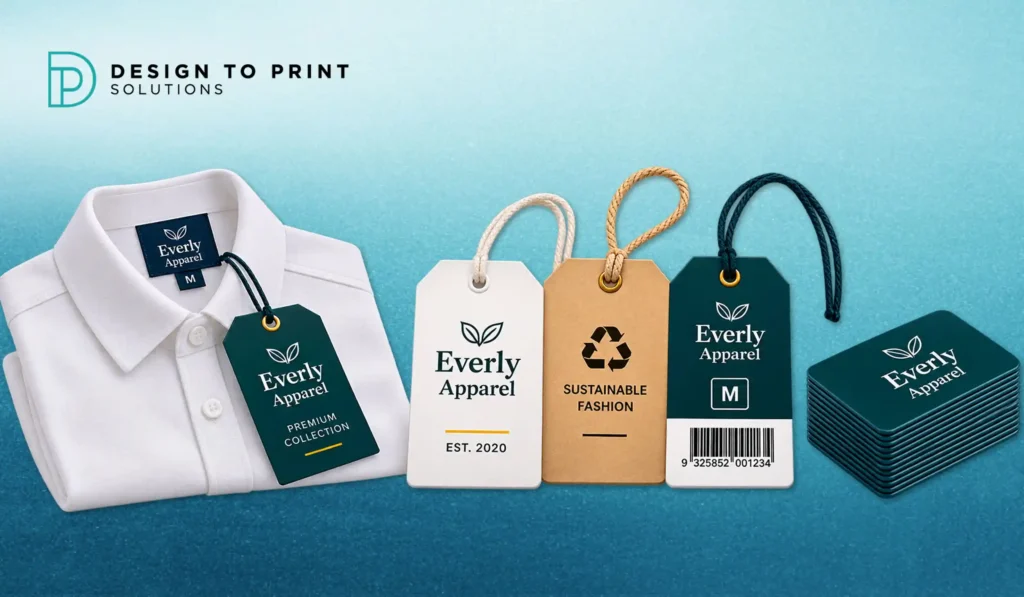
Swing tags for clothing brands do more work than their size suggests. On a rack of twenty similar garments, the tag is often the only branded surface a customer can actually read before touching the price. It carries the brand name, the story, the size, the barcode and the price, and it does all of that on a piece of card smaller than a business card.
Get it right and the tag lifts a garment from generic to considered. Get it wrong and you end up with tags that tear at the hole, barcodes that will not scan at the counter, or a stock so thin it curls in a humid stockroom before the season has even started.
This guide covers the sizes and shapes that work in retail, how to choose stock and finish, what information belongs on the tag and what legally belongs elsewhere, how to attach them, and how to set up artwork so the first run comes back right.
Standard Swing Tag Sizes
There is no fixed industry standard, but a handful of sizes recur because they suit racks, hands and printing efficiently.
Small portrait tags, around 40 x 70mm or 45 x 80mm, suit minimal brands where the tag carries a logo, a size and a barcode. They sit neatly against the garment and do not flap on a crowded rack.
Business card footprint tags, around 50 x 90mm, are the most common all-rounder. There is room for branding on one side and practical detail on the other without the tag becoming obtrusive.
Tall narrow tags, around 40 x 120mm, look considered on premium and minimalist labels and give vertical room for a brand story or a care note.
Square tags, usually 55 x 55mm or 70 x 70mm, suit streetwear and modern labels where the logo does most of the talking.
Larger tags, around 70 x 120mm and above, suit garments that need a story panel, a size chart, sustainability information or a care guide. These are more common in outerwear, denim and technical apparel where the purchase decision involves more information.
A practical note on size: the tag has to work on the garment it is attached to, not just on the desk. A large tag on a lightweight silk camisole drags the fabric and looks clumsy, while a tiny tag on a heavy wool coat disappears entirely. Check proportions against your actual range before committing.
Shapes and Die Cutting
Rectangular tags with rounded corners are the default for good reason. Rounded corners resist bending and dog-earing in a stockroom and on a rack, which keeps the range looking fresh for longer than square corners do.
Die cut shapes, such as a tag silhouette with angled top corners, a circle, or a custom outline matching a brand mark, add distinctiveness. They need a clean vector dieline supplied as a separate layer, and you should keep text and barcodes well clear of the cut edge.
Folded tags are worth considering when you need more information than a single panel allows. A simple folded tag effectively gives four panels: branding on the front, story or size chart inside, and practical detail on the back, without increasing the footprint on the rack.
Choosing Stock and Weight
Swing tags need to be considerably heavier than a flyer, because they are handled repeatedly, hang under their own weight and go through a hole punch and a string.
Lighter card feels cheap in the hand and tears at the hole, which is the most common failure point. Heavier card holds its shape, survives handling and signals quality immediately, which matters most on premium ranges. As a general rule, swing tags sit at the heavier end of the stock range compared with most commercial print, and for premium ranges heavier again, sometimes with two sheets bonded together for a substantial, rigid feel.
Uncoated and textured stocks suit natural fibre brands, slow fashion and premium labels. They take letterpress, embossing and foil beautifully and feel tactile in the hand. They mark more easily, so they suit ranges where the tag is handled by the customer rather than surviving months in a warehouse.
Coated stocks with a laminate give stronger colour reproduction and far better durability for high turnover retail, children’s wear and anything shipped repeatedly between stores.
Recycled and kraft stocks carry an immediate sustainability signal that aligns with many apparel brands. Keep in mind that a brown or grey base tone mutes every printed colour, so bright artwork will not reproduce as it does on white stock. Our guide to CMYK and RGB colour in printing explains why the same file looks different on different stocks.
Finishes That Signal Price Point
Finish is where a swing tag earns its premium positioning, because a customer feels the tag before they read it.
Matt laminate is the practical default for retail durability and gives a soft, modern look. Soft touch laminate adds a velvety tactile quality that performs particularly well on dark tags for premium and streetwear labels.
Foil stamping on a logo or brand mark is the clearest premium signal available at this size, and because the tag area is small, foiling a swing tag is a far more economical way to use foil than applying it across a large printed piece.
Embossing and debossing give structural dimension that survives handling, which works beautifully on uncoated and textured stocks where the impression is visible and tactile.
Spot UV over a matt base creates contrast that catches retail lighting, useful for highlighting a monogram or pattern.
Edge painting, where the cut edges of a thick tag are coloured, is a detail that reads as genuinely high end on bonded or heavyweight stocks.
What to Print on a Swing Tag
The Front
Keep it to the brand. A logo, and at most a short descriptor or tagline. The front of the tag is a brand surface, not an information panel, and crowding it defeats the purpose.
The Back
This is where the practical information lives: size, style or SKU code, colour name, barcode, and often the price, either printed or applied as a separate sticker.
Barcodes need care. Supply the barcode at the correct magnification with adequate quiet zones either side, and in solid black on a light background. Barcodes printed in colour, reversed out of a dark background, placed over a pattern or squeezed too small will fail at the counter, and a scanner failure at point of sale is the fastest way to turn a nice tag into a reprint.
The Optional Panels
Brand story, size chart, sustainability credentials, country of origin, care guidance and social handles all work well where there is room, particularly on folded or larger tags. A QR code linking to a size guide, a styling page or a product page is increasingly common, and worth including only if the destination page is live, mobile friendly and permanent.
What Legally Belongs on the Garment, Not the Tag
This is the detail that catches new apparel brands out.
Care labelling is mandatory in Australia for clothing and a range of textile products under the Consumer Goods (Care Labelling) Information Standard 2023, which is administered by the ACCC. Care instructions may be provided in written English, using the international care symbols under ISO 3758, or both.
The key point for swing tags is that the care information must be attached to the product in a way that stays with it, which in practice means a sewn-in or permanently affixed label, not a swing tag the customer removes and discards at home. Printing care instructions on the swing tag is useful additional information, but it does not satisfy the requirement on its own.
Fibre composition, such as “100% cotton”, is not required by that care labelling standard, though many brands include it because customers expect it. Where you do state it, or make any claim about origin, materials or sustainability, it must be accurate, since misleading representations are covered by Australian Consumer Law. This is general guidance rather than legal advice, so confirm your obligations for your product range before you print.
Attachment: String, Pins and Fasteners
The attachment is part of the product experience and is often decided last, which is a mistake.
Hole position matters. A single hole centred at the top is standard. Keep it far enough from the edge that the card does not tear, and heavier stock tolerates a hole closer to the edge than light stock does.
Cotton or jute string suits natural fibre and sustainable brands. Satin ribbon suits occasion wear and premium ranges. Elastic loops are convenient for garments where the tag needs to slip over a hanger or a button. Plastic tagging barbs applied with a tagging gun are fastest for high volume retail, though they conflict with the positioning of brands marketing on sustainability.
Safety pins and bulldog clips avoid piercing delicate fabrics, which matters for knitwear, silk and fine weaves where a tagging barb leaves a visible hole.
Decide the attachment before finalising artwork, because it determines hole size, hole position and how much clear space the design needs at the top of the tag.
Artwork Setup
Supply print-ready PDFs in CMYK with 3mm bleed on all edges, and keep text, barcodes and logos at least 4mm inside the trim. Mark the punch hole position on a separate layer so it does not land on a logo or through a barcode.
Place images at 300dpi at final size, outline or embed fonts, and supply any die cut shape as a vector dieline on its own layer. Set foil, emboss and spot UV areas as named spot colour layers set to overprint so the finishing areas are unambiguous.
If your tags carry variable data such as sizes, colours or style codes, plan the versioning at the start. It is far more efficient to produce a set of versions in one run than to reorder individually later in the season.
At Design to Print Solutions (DTPS), our team checks every supplied file before production and flags issues such as missing bleed, low resolution logos, RGB colour and barcodes set too small or in insufficient contrast to scan reliably.
Most apparel brands end up needing a matched set alongside the tags, including printed packaging boxes for online orders, custom stickers for sealing and seasonal promotions, labels for dispatch and sizing, business cards for markets and wholesale, and laminated postcards as thank you inserts.
Send through your sizes, quantities, stock preference and artwork, and we will come back with an itemised quote and a recommended stock, finish and attachment for your range. Request a free quote or browse swing tag printing and our full printing services.
FAQ:
What card weight is best for swing tags?
Swing tags need noticeably heavier stock than general print, because they hang under their own weight and pass through a punched hole. Light card feels cheap and tears at the hole, which is the most common failure point. Premium ranges often use very heavy stock or two bonded sheets for a rigid, substantial feel.
Do I have to put care instructions on the swing tag?
No, and a swing tag alone does not satisfy the requirement. Care labelling is mandatory in Australia under the Consumer Goods (Care Labelling) Information Standard 2023, and the information must stay with the garment, which means a sewn-in or permanently attached label rather than a tag the customer removes. Printing care guidance on the swing tag as well is useful, but not a substitute.
Why does my barcode not scan at the counter?
Usually size, contrast or placement. Barcodes need to be reproduced at the correct magnification with clear quiet zones on both sides, printed in solid black on a light background. Reversing a barcode out of a dark colour, printing it over a pattern, laminating heavily with a reflective gloss, or scaling it down to fit will all cause scanning failures.
What is the best way to attach swing tags to garments?
It depends on the fabric and the brand positioning. Cotton or jute string suits natural fibre and sustainable labels, satin ribbon suits occasion wear, and plastic tagging barbs are fastest for high volume retail. For delicate fabrics such as silk or fine knitwear, use safety pins or clips rather than barbs, which leave a visible hole.
Can I print different sizes and colours in one order?
Yes. Versioned swing tags are straightforward to produce as a single run, which is more efficient than ordering each size or colourway separately through the season. Plan the versioning before artwork is finalised so the variable elements sit in a consistent position across every tag.