
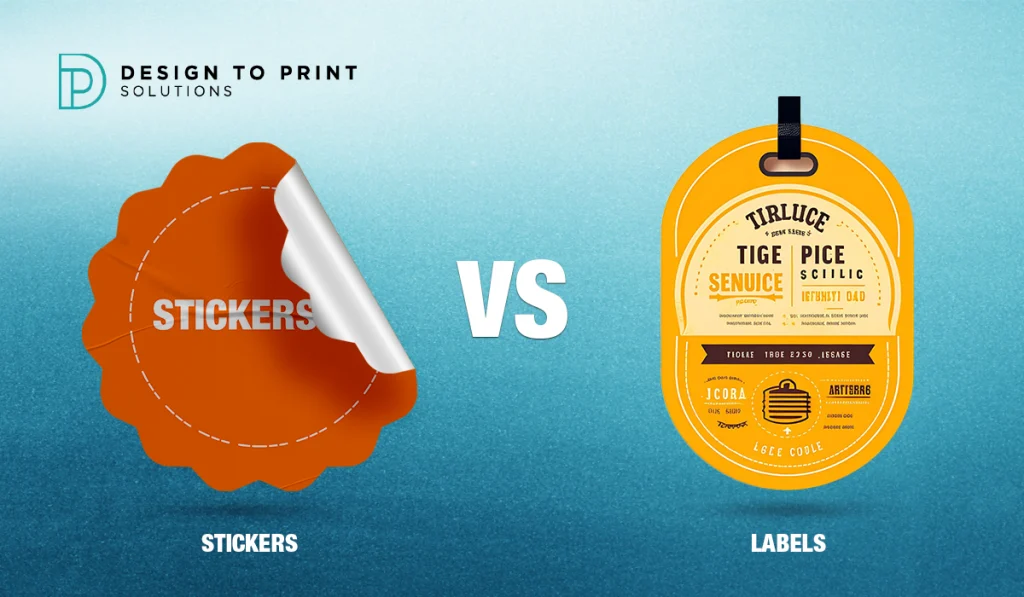
The main difference between sticker printing and label printing is purpose.
Stickers are designed for branding, promotion, or decoration, while labels are designed to identify products, display information, and meet compliance requirements when applied to packaging.
When many people talk about stickers and labels, they treat the terms as interchangeable. But in printing and packaging industries — including here at DTPS — there is a meaningful distinction between stickers printing and labels printing. Understanding that difference helps you pick the right product for your need, avoid waste, and present a more professional final result.
On top of that, digital printing has changed how both stickers and labels are produced, making short-run custom jobs more affordable, faster, and higher quality. But even with that convergence, the purpose, materials, formats and finishing options still diverge.
Sticker Printing vs Label Printing: What’s the Difference?
Sticker printing is used for branding, promotions, and decorative purposes, while label printing is used to display product information, barcodes, and compliance details on packaging. Stickers focus on visual impact and flexibility, whereas labels prioritise readability, adhesion, and regulatory requirements. Choosing the right option depends on usage, environment, and application method.
Stickers vs Labels: Core Definitions and Use Cases
- Sticker printing refers to printing products intended as standalone promotional or decorative items. Stickers are often individually cut, designed to be given away, affixed to surfaces like laptops or water bottles, or used for branding swag.
- Label printing refers to printing products intended to convey information or identification when affixed to packaging, products or components. Labels may carry regulatory text, barcodes, batch codes, ingredients or instructions.
Stickers tend to prioritise design freedom, visual impact and durability (especially outdoors), while labels focus on readability, adherence, regulatory compliance and consistent reproduction. The materials and adhesive choices will reflect those purposes.
Why Does the Difference Matter?
If you treat stickers and labels as the same, you risk:
- Choosing a material that’s overkill (and over cost) for your use
- Using a design style that undermines legibility for regulatory labels
- Having peeling, fading or misadhesion because you used the wrong adhesive
- Failing to meet compliance (food, cosmetic, hazard, etc.)
- Not capitalising on cost savings from roll printing or batch printing efficiencies
At DTPS, we consider the end use first, then select substrate, adhesive, finish and print method to align with that need.
What is a sticker?
A sticker is a self‑adhesive printed piece, typically cut to shape, used primarily for decoration, branding or promotion.
Stickers are often made with durable vinyl, coated film or synthetic stock and laminated for outdoor use. They’re usually individually cut (die‑cut or kiss‑cut) and intended to be distributed, applied to surfaces like laptops, bottles or signage. Because their final surface can vary, sticker choices favour flexible adhesives and robust protection against UV, moisture and wear.
What is a label?
A label is an adhesive medium printed with specific information to identify or describe a product, container or item.
Labels are typically supplied in sheets or rolls, and are placed on packaging, bottles, boxes or industrial parts. They often carry essential data (batch numbers, ingredients, barcodes, safety instructions), so the priority is clarity, adhesion, durability, and compliance. Labels may favour substrates like BOPP, PET or coated paper, with adhesives optimised for the target surface (glass, plastic, metal).
Can you use a sticker as a label (or vice versa)?
In some cases, yes — but it’s rarely optimal because the design, adhesive, or substrate may be mismatched for the intended use.
For example, a vinyl sticker might stick to a product container but lack the compliance or adhesive properties needed for long-term wear under heat or moisture. Conversely, a label might be too thin or lack aesthetic appeal for a promotional sticker. Matching the use, not just the look, is crucial in printing decisions.
Sticker vs Label: Real-World Use Examples
- Stickers:
Laptop branding, event giveaways, promotional packs, window decals - Labels:
Food jars (ingredients & allergens), cosmetic bottles, shipping cartons, compliance labels
Key Differences Between Sticker Printing and Label Printing
Here’s a side‑by‑side comparison of the major differentiators:
| Characteristic | Sticker Printing | Label Printing |
| Purpose | Promotional, decorative, branding, giveaways | Identification, information, compliance |
| Format | Individually cut, die‑cut, kiss‑cut | Delivered in sheets or rolls |
| Material/Substrate | Vinyl, synthetic film, laminated finishes | Coated paper, BOPP, PET, specialty label stocks |
| Adhesive Strategy | Flexible — removable or permanent, suited to many surfaces | Strong adhesion tailored to container surface (glass, plastic, metal) |
| Durability / Finish | High resistance to UV, moisture, wear (especially outdoors) | Balanced for readability, permanence, resistance to chemicals or conditions |
| Cost & Volume Efficiency | Better for short runs / custom shapes | More efficient at scale, especially roll printing |
| Design Freedom | Creative shapes, full bleed, visual impact | Standard shapes, more constrained by space and readability |
Many printing providers (including DTPS) now handle both under the umbrella of digital printing, but the specifications behind each application remain distinct.
How Digital Printing Changes the Game (for Both Stickers & Labels)
Digital printing (especially digital inkjet or toner-based processes) allows you to print small batches at high quality without expensive tooling. It’s ideal for rapid iterations, test runs or small product lines. That flexibility benefits both sticker printing and labels printing — enabling you to:
- Produce short runs economically
- Personalise or vary designs per item (e.g. variable data printing)
- Shorten lead times
- Avoid costly setups like plates or dies
However, even with digital printing, you must still carefully select substrates, adhesives and finishing (lamination, varnish, overcoats) to ensure the printed output meets the real-world demands of its application.
When to Choose Sticker Printing vs Label Printing
To decide between sticker printing and label printing (or a hybrid approach), consider the following:
- Purpose & messaging: Use a label when the primary goal is to convey information; favour a sticker when brand impact or promotion is central.
- Surface & environment: Is the item exposed to moisture, heat, abrasion or outdoor conditions? That steers you toward more robust materials and adhesives.
- Shape & visual design: If you want irregular or custom outline shapes, a sticker format offers more flexibility.
- Volume and repeatability: High volumes may favour roll labels for faster application; low volumes or custom one-offs may lean toward stickers.
- Cost-efficiency: Balancing material costs, finishing, setup and production scale is essential — sometimes the “right” choice is the one that avoids over-engineering.
At DTPS, we work with clients to map out the intended use before proposing sticker or label solutions that deliver performance and cost-effectiveness.
Tips & Best Practices for Quality Sticker & Label Results
- Always test adhesives on your actual surface (plastic, glass, metal, corrugated)
- Consider bleed margin and safe zone in your design (especially for die‑cut shapes)
- Use vector artwork where possible to maintain crisp edges
- Lamination or over‑coating protects against abrasion, UV and moisture
- For roll labels, ensure printer alignment (registration) is precise
- For stickers, select a strong liner (backing) to prevent blocking or damage
- Think ahead — will the item ever be exposed to solvents, cleaning, heat or outdoor elements?
These best practices help ensure your printed materials deliver reliably and reinforce your brand’s perceived quality.
Why Choose DTPS for Sticker Printing & Label Printing in Australia
At DTPS, we combine industry experience, print expertise and local service to deliver tailored sticker printing, labels printing and digital printing solutions across Australia. Whether you need a branded sticker campaign or compliance labels for your product line, we:
- Consult on materials, adhesives and environment factors
- Offer digital print capabilities suited to small and large volumes
- Produce finishes (lamination, varnish, coatings) that enhance durability
- Ensure colour fidelity, consistency and fast turnaround
- Integrate with your packaging or branding workflow
We understand that the difference between a great sticker and a poor label is often in the details — and we pay attention.
Wrap-Up & Key Takeaways
- Stickers and labels may look similar, but their roles, materials, formats and performance requirements differ.
- Sticker printing emphasises visual appeal, flexibility, and durability in variable locations.
- Label printing emphasises clarity, adherence, and regulatory or informative function.
- Digital printing bridges much of the cost gap between setups — but you still must design for function.
- At DTPS, we help you pick the right approach — sticker, label, or blended — for superior outcomes.
FAQ:
What printing methods are used for stickers and labels?
Both stickers and labels can be produced using:
Digital printing (best for short runs, customisation, fast turnaround)
Offset printing (best for very large volumes with consistent designs)
Flexographic printing (commonly used for high-volume roll labels)
DTPS primarily uses digital printing for flexibility and efficiency across many applications.
Can stickers and labels be used interchangeably?
Sometimes, but it’s not recommended. A sticker may lack the adhesive strength or compliance features required for a label, while a label may not have the durability or visual impact expected from a sticker. Choosing the right product avoids failure, waste, and reprints.
What materials are available for sticker and label printing?
Common materials include:
Vinyl and synthetic films (durable, weather-resistant)
Coated paper stocks (cost-effective for indoor use)
BOPP and PET (popular for packaging labels)
Specialty materials for heat, moisture, or chemical resistance
Material choice depends on environment and surface.
What types of adhesives are used?
Adhesives vary based on application:
Permanent adhesives
Removable adhesives
Freezer-grade or high-tack adhesives
Adhesives for glass, plastic, metal, or cardboard
Testing on the real surface is always recommended.
What is die-cut vs kiss-cut?
Die-cut stickers are cut all the way through the material and backing.
Kiss-cut stickers are cut through the sticker layer only, leaving the backing intact.
Kiss-cut is common for sheets; die-cut is common for individual stickers.
What is the minimum or maximum size for stickers or labels?
Sizes range from small barcode labels to large-format stickers. Minimum size is limited by legibility and cutting accuracy; maximum size depends on substrate and intended use. DTPS can advise on optimal sizing for performance and cost.
Are stickers and labels waterproof or weatherproof?
They can be. Vinyl, laminated, or synthetic materials offer strong resistance to water, UV, and wear. Paper labels are less durable unless coated or laminated. Always specify environmental exposure when ordering.
How long will printed stickers or labels last?
Durability depends on:
Material
Adhesive
Lamination or coating
Exposure to sunlight, moisture, chemicals
Outdoor-grade stickers can last several years; standard labels are designed for product lifecycle use.
How should I prepare artwork for sticker or label printing?
Best practices include:
Supplying vector files where possible
Including bleed and safe margins
Using CMYK colour mode
Outlining fonts
Providing high-resolution images
DTPS can review and adjust artwork before print.
Can I get variable data printing (VDP) for labels or stickers?
Yes. Variable Data Printing (VDP) allows each sticker or label to include unique information such as serial numbers, QR codes, barcodes, names, or batch details. Digital printing makes VDP efficient and cost-effective, especially for labels.
What’s the difference between digital printing and offset printing?
Digital printing is ideal for short runs, fast turnaround, and variable data.
Offset printing is better for very large volumes with identical designs.
For most modern sticker and label applications, digital printing offers better flexibility and lower setup costs.
