
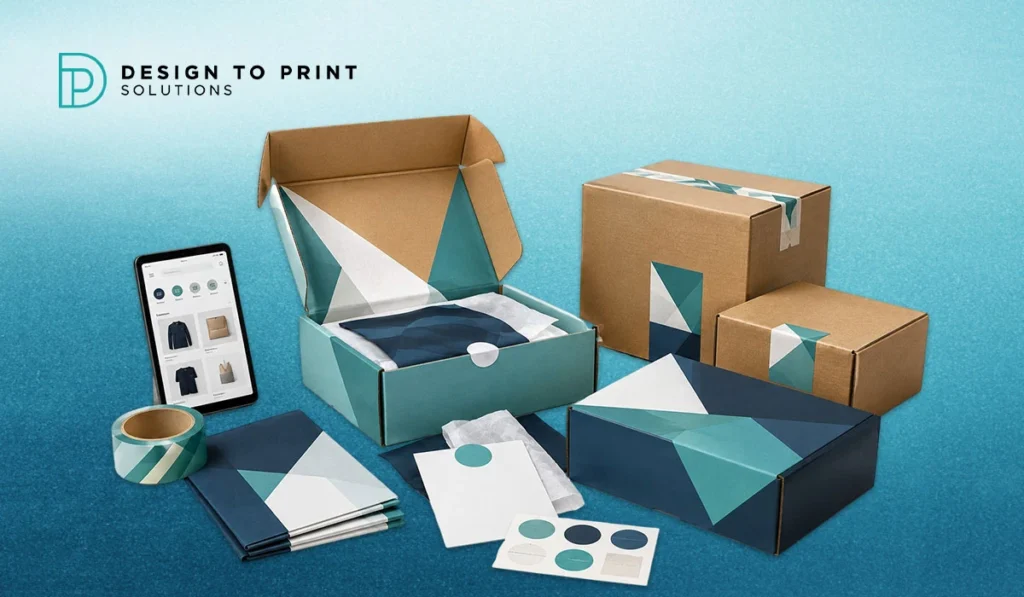
The box your customer opens is the only physical moment in an otherwise digital sale. They order on a screen, pay on a screen, then a courier drops something real on the doorstep. Whether that something feels considered or thrown together tells the customer more about your brand than your website ever will.
For Melbourne e-commerce brands, custom packaging boxes have shifted from a nice extra to a working part of the marketing budget. This guide walks through the choices you actually face when you order branded boxes for the first time: the box styles, the materials, how sizing works, what you can print, and how to hand artwork to a printer without the job going sideways.
Why custom boxes matter more for online brands
A retail product sits on a shelf next to competitors, so the packaging fights for attention at the point of sale. An online product travels in the dark, gets handled by couriers, and then appears in one moment on a kitchen bench. That single reveal is your shopfront.
Custom boxes do three practical jobs at once. They protect the product in transit so you get fewer damaged-goods refunds. They carry your branding, so an unboxing photo on Instagram doubles as free advertising. And they signal price positioning: a plain grey mailer and a printed rigid box tell the buyer two very different things about what they paid for.
None of that requires a huge budget. Digital printing has made short runs realistic, so a small Melbourne brand can order branded boxes without committing to tens of thousands of units.
The main box styles, and who they suit
Most e-commerce packaging falls into a handful of formats. Picking the right one is mostly about product weight, how premium you want it to feel, and your shipping method.
Mailer boxes are the workhorse of online retail. They fold flat, self-lock without tape, and open with that satisfying wing action that suits an unboxing. The outside and inside can both be printed, which is why so many subscription and apparel brands use them. They suit anything from cosmetics to small electronics.
Corrugated shipping boxes are the tougher option for heavier or more fragile items. The fluted inner layer absorbs knocks, so they are the sensible choice for glassware, bottled goods, or anything that has to survive a rough courier run.
Rigid boxes are the premium end: a solid, non-folding box with a separate lid, the sort you see around jewellery, tech, or high-end skincare. They cost more and take longer to make, but they carry a luxury feel that thinner stock cannot fake.
Product boxes and cartons are the lighter retail-style boxes for items that also need to look good on a shelf or in a hamper. Think tea, candles, or food gifting.
Inserts and dividers sit inside any of the above. A custom insert holds the product still, stops rattling, and makes the open feel deliberate rather than loose.
If you sell a mixed range, you do not have to choose only one. Many brands run a printed mailer for standard orders and a rigid box for a premium or gift line.
Materials and weight, in Australian terms
Paper and board are measured here in GSM (grams per square metre). Higher GSM means thicker, stiffer stock. For folding cartons and printed retail boxes you are usually somewhere between 250 and 400 GSM. Corrugated board is described by its flute grade instead, which controls how much cushioning and stacking strength you get.
A few material choices worth knowing:
- Kraft board has a natural brown finish and reads as honest and eco-minded. It suits brands that want an understated, sustainable look.
- White board (SBS) gives you a clean, bright surface that makes colours and photography pop. It is the go-to when print quality matters.
- Recycled and FSC-certified stocks let you back up sustainability claims that Australian shoppers increasingly ask for. If “eco-friendly” is part of your pitch, the material has to earn it.
The right weight is a balance. Too light and the box feels flimsy and dents. Too heavy and you pay for board you did not need and push up your shipping weight. This is worth a quick conversation with your printer rather than guessing.
Print, finishes and the unboxing feel
This is where a box stops being a container and starts being brand. Your options generally include full-colour printing on the outside, inside, or both, plus finishing touches that change how the box feels in the hand.
Common finishes include matte or gloss lamination, which changes the surface sheen and adds durability; spot UV for a raised, glossy highlight on a logo; and foiling, embossing or debossing for a tactile, premium detail. You do not need all of them. One well-chosen finish on the right stock usually beats a box loaded with every effect at once.
A cheap trick that punches above its cost: print the inside of a mailer box. It costs a little more, but the burst of colour or a short message when the customer lifts the lid is exactly the moment they are most likely to photograph.
If you are printing logos and brand colours, it helps to understand how ink behaves on different stocks. Our guide on coated versus uncoated paper explains why the same artwork can look sharp on one surface and soft on another.
Sizing: measure the product, not the old box
The single most common packaging mistake is ordering a box that does not fit. Boxes are quoted by internal dimensions in millimetres, listed as length x width x height, because that is the space your product actually sits in.
Measure the product itself, then allow a little room for any protective insert or wrap. A box that is too big means wasted void fill, higher shipping costs, and a product that slides around. A box that is too tight is a nightmare to pack and can split at the seams. If you sell a range of sizes, it is often cheaper to standardise on two or three box sizes than to order a custom size for every SKU.
Order quantities, lead time and budget
Cost per box drops as quantity rises, which is the tension every new brand feels: order more to get a better unit price, or order less to protect cash flow and test the market first.
Digital printing has softened this. Short runs are now viable, so you can order a modest batch of printed boxes, see how customers react, and refine before committing to a large volume. When you plan a launch, build in lead time for artwork approval, a printed sample if you want to check colour in the flesh, and production. Rigid boxes and specialty finishes take longer than a straightforward printed mailer, so factor that into any dated campaign.
The variables that move your quote are quantity, box style, material and weight, print coverage, and finishes. Give your printer all five up front and the quote comes back faster and closer to final.
Getting your artwork right
Even a beautiful design prints badly if the file is not set up for production. A few essentials:
- Work in CMYK, not RGB, so screen colours translate to print without nasty surprises.
- Supply artwork on the printer’s dieline (the flat template that shows fold and cut lines) so your design lands in the right place once the box is folded.
- Keep important text and logos away from fold lines and edges.
- Send print-ready files, usually a press-ready PDF, with fonts outlined and images at high resolution.
If file formats make your eyes glaze over, our breakdown of which file format printers actually need covers PDF, AI, PNG and the rest without the jargon.
Where to start in Melbourne
Working with a local printer has real advantages for a Melbourne brand: you can see and feel a sample, colours are easier to sign off in person, and turnaround does not depend on an overseas freight run. Design to Print Solutions handles both the design and the print in-house, with no minimum order, which makes it straightforward to test branded packaging before you scale it. If you also produce stickers, swing tags or product labels, keeping them with the one supplier keeps your brand colours consistent across every piece.
Custom packaging is one of those investments that quietly pays for itself in repeat photos, fewer damaged returns, and a brand that looks like it means business. Start with the box style, get the size right, and the rest follows.
Ready to price your boxes? Request a quote and tell us your product, rough dimensions and quantity to get started.
Frequently asked questions
What is the minimum order for custom printed boxes?
It depends on the box style and print method. Digital printing makes short runs viable, so small brands can order a modest batch to test the market rather than committing to thousands of units. Ask your printer what the practical minimum is for the style you want.
How much do custom packaging boxes cost in Australia?
Price is driven by quantity, box style, material and weight, how much of the box is printed, and any finishes like lamination or foiling. Cost per box falls as quantity rises. The fastest way to a real number is to send those details and request a quote.
What is the best box for an e-commerce brand shipping fragile items?
Corrugated shipping boxes, ideally with a custom insert to hold the product still. The fluted board absorbs courier knocks, and the insert stops movement that causes breakages in transit.
Can I get eco-friendly or recyclable packaging?
Yes. Kraft board, recycled stocks and FSC-certified options are all available. If sustainability is part of your brand message, choose a material that genuinely supports the claim rather than relying on wording alone.
What size box should I order?
Measure your product in millimetres and allow a little room for any insert or protective wrap. Boxes are quoted by internal dimensions as length x width x height. Standardising on two or three sizes across your range is usually cheaper than a custom size per product.
What files do you need to print my packaging?
Press-ready artwork set up in CMYK on the supplied dieline, with fonts outlined and images at high resolution, usually as a PDF. If you are unsure, send what you have and your printer can advise what needs fixing before production.
